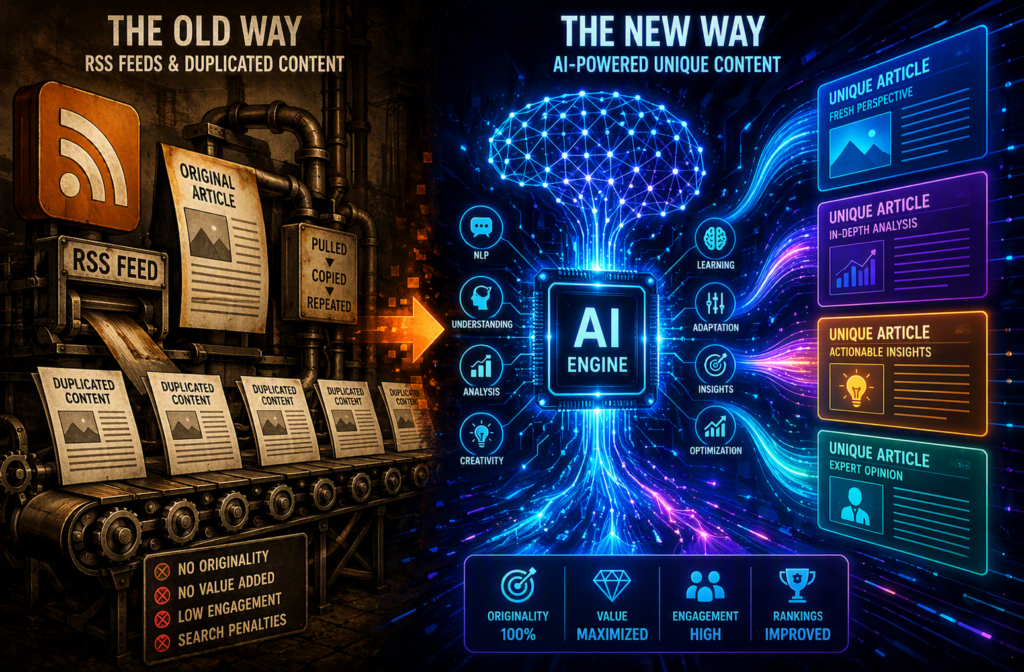
By the time you finish reading this sentence, thousands of automated AI blog posts have just been published across the internet. In the frantic race to build organic traffic and topical authority in 2026, WordPress developers and marketing agencies are no longer writing articles manually. The game has shifted entirely to programmatic SEO and AI-driven content generation.
However, a massive divide has opened up in the WordPress plugin ecosystem. On one side, you have traditional, consumer-grade autobloggers that simply pull text from an API and dump it into your database. On the other side, you have advanced, developer-first architectures designed to build complex, native Gutenberg layouts while meticulously managing server resources.
Today, we are putting two of the most discussed tools head-to-head: WPAutoblog vs Hero AI Blogger.
If you are an agency owner managing dozens of client staging environments, or a developer looking to scale a massive topical silo without crashing your database, this comprehensive technical comparison will show you exactly which plugin deserves a place in your tech stack.
1. High-Level Overview of the Contenders
Before diving into the code-level architecture, it is important to understand the fundamental philosophy driving both of these tools. They are solving the same problem—automated content creation—but they are built for entirely different types of users.
WPAutoBlog: The Consumer-Friendly Writer
WPAutoBlog has built a solid reputation as a straightforward, accessible tool for casual bloggers and affiliate marketers. It operates as an all-in-one Software as a Service (SaaS) platform that connects to your WordPress site remotely via the REST API. You log into their external dashboard, set up a scheduling cadence, and the platform uses models like ChatGPT to push content directly to your site. It handles the basics well: generating long-form articles (up to 2,000 words), adding basic stock photos from Unsplash, and utilizing smart auto-linking to connect your posts.
Hero AI Blogger: The Developer-First Architecture
Hero AI Blogger takes an entirely different approach. Instead of acting as an external SaaS platform that treats WordPress as a simple text receptacle, Hero AI Blogger acts as a native, highly integrated React application living directly inside your WordPress admin dashboard. It is engineered specifically for developers, agencies, and technical SEO professionals who demand absolute control over their output. It focuses heavily on strict Gutenberg block assembly, automated code testing, server-side fail-safes, and deep programmatic SEO capabilities.
2. The Core Difference: Text Generation vs. Block Assembly
The most critical factor in this comparison is how each plugin actually handles the content formatting. Search engines in 2026 require far more than just 1,500 words of standard paragraph text. They require rich, structured media, comparison tables, FAQ schemas, and varied heading structures.
How WPAutoBlog Handles Formatting
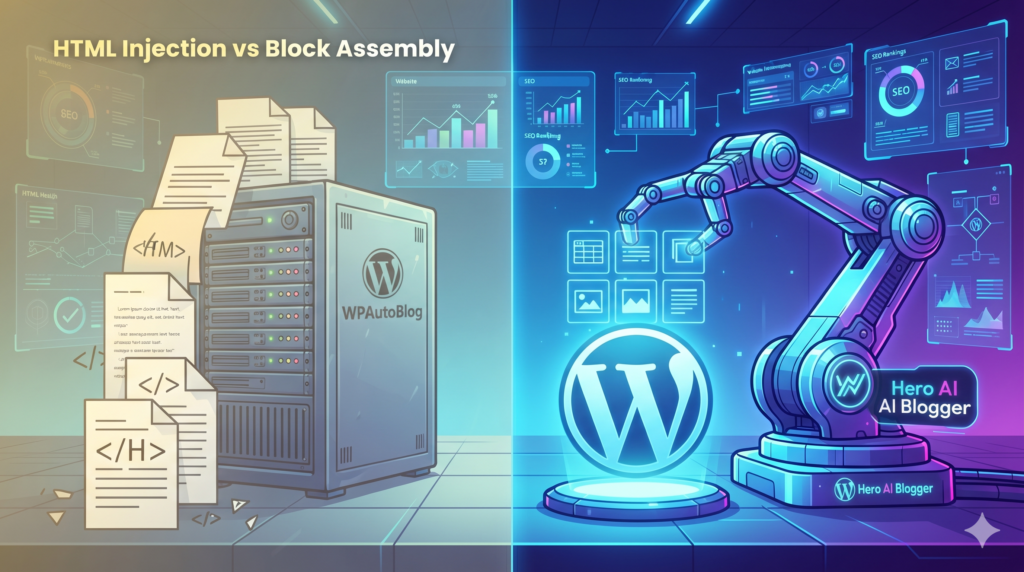
Because WPAutoBlog operates externally, its primary method of delivery is HTML injection. The AI generates the content, wraps it in standard HTML tags (<h2>, <p>, <ul>), and pushes it via the REST API into the classic post_content field.
While this works perfectly fine if you are still using the Classic Editor, it introduces severe friction for modern websites. When raw HTML is forced into a modern WordPress theme, Gutenberg often fails to recognize it natively. If a client goes in to manually edit a WPAutoBlog post, they will frequently encounter the dreaded “Attempt Block Recovery” error because the injected HTML does not match Gutenberg’s strict proprietary JSON comment syntax.
How Hero AI Blogger Handles Formatting (The Winner)
Hero AI Blogger completely eliminates this issue by utilizing advanced block-level assembly.
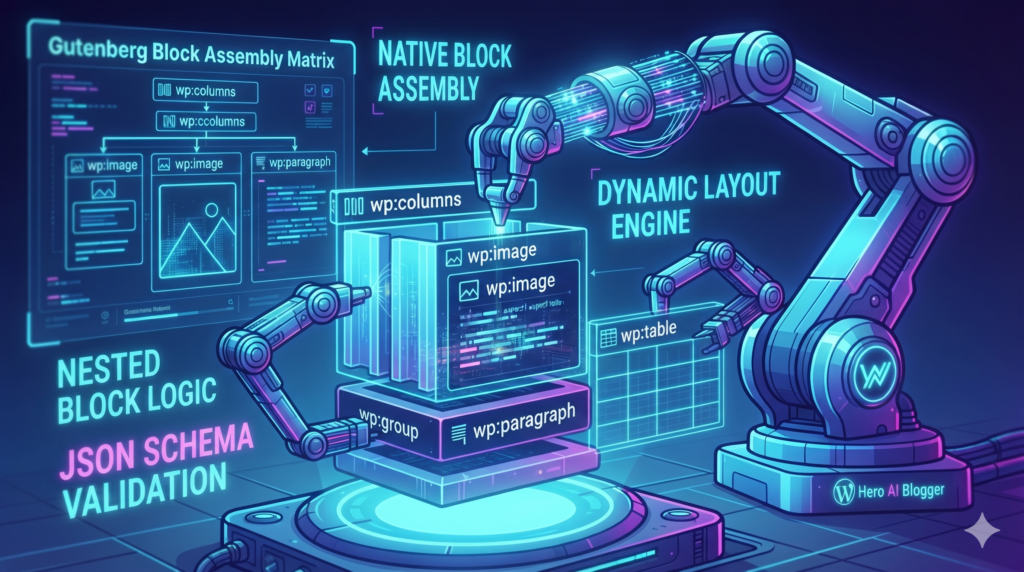
Instead of relying on basic text wrappers or raw HTML, Hero AI Blogger’s server-side engine translates the AI’s output into perfectly valid, interlocking Gutenberg blocks before it ever touches your database.
When Hero AI Blogger generates a post, it is not just writing words; it is architecting a dynamic layout. It natively constructs wp:table blocks for data comparisons, embeds wp:image blocks with correctly formatted alignment classes, and injects wp:html blocks containing perfectly validated JSON-LD Schema markup in the background.
For developers, this means the automated content perfectly inherits the active theme’s global CSS variables and typography rules. It guarantees that the site remains 100% compliant with modern block standards, drastically reducing the risk of broken layouts when transitioning to Headless WordPress architectures or React-based frontends like Next.js.
3. Infrastructure and Server Safeguards: Preventing the Crash
Scaling a site from 50 pages to 5,000 pages overnight sounds great in a marketing brochure, but it is a nightmare for your server. Generating thousands of words of AI content simultaneously requires massive PHP worker bandwidth and constant database write-access.
The WPAutoBlog Approach to Scaling
Because WPAutoBlog processes the AI generation on its own external servers and pushes the final result to your site via the REST API, it spares your server from the heavy lifting of the actual API wait times. This is an advantage for users on cheap, shared hosting plans.
However, this remote-push method lacks deep context about your specific server environment. If your database is temporarily locked, or if an aggressive security plugin blocks a burst of incoming REST requests, external platforms often fail to interpret the local error correctly. This can result in skipped articles or duplicated drafts.
The Hero AI Blogger Approach (The Winner)
Hero AI Blogger runs natively within your environment, granting it unparalleled access to monitor and protect your server’s health.
When executing high-volume programmatic SEO campaigns, Hero AI Blogger relies on a proactive, built-in Token Exhaustion Engine. Before initiating a batch generation script via WordPress cron, the plugin executes a lightweight pre-flight check. It calculates the estimated API token weight required for the keyword cluster and checks the current API rate limits natively.
If it detects an imminent limit breach—or if the local server’s PHP memory allocation spikes dangerously high—Hero AI Blogger executes a “Smart Pause.” It safely stores the exact layout state in a secure WordPress transient, gracefully halts the execution queue, and dispatches an administrative alert.
Furthermore, because it utilizes a decoupled React front-end communicating asynchronously with custom REST endpoints (/wp-json/hero-ai/v1/), administrators can watch massive generation queues process in real-time without locking up their admin-ajax.php file or crashing the WordPress backend.
If you missed Part 1, we established that while WPAutoBlog is a strong contender for casual users looking to generate content from an external dashboard, Hero AI Blogger utilizes a native, React-based block assembly engine that is far superior for developers who need strict control over Gutenberg layouts and server health.
4. Programmatic SEO and Topical Silo Generation
In 2026, publishing random, disconnected articles is a guaranteed way to waste your crawl budget. To build genuine authority, search engines require tightly knit topical clusters. Both WPAutoBlog and Hero AI Blogger offer solutions for this, but their execution methods differ drastically.
WPAutoBlog: The Linear Approach
WPAutoBlog features a built-in keyword research tool and a topic cluster generator. You can input a broad keyword, and the platform will generate a list of related topics. Its “Smart Autolinking” feature scrapes your site’s sitemap and automatically places internal links to your existing content.
This is highly convenient for a hands-off approach. However, because it relies on scraping a sitemap rather than querying the live WordPress database, the internal linking can sometimes lack semantic precision. It builds a linear web of links, but it struggles to build strict, tiered hierarchical silos where link equity flows perfectly from a pillar page down to specific sub-cluster pages.
Hero AI Blogger: The Semantic Hub-and-Spoke Model (The Winner)
Hero AI Blogger was built explicitly for complex Programmatic SEO. Instead of just scraping a sitemap, it acts as an Agentic AI Ecosystem that directly queries the WordPress REST API to map your entire database structure.
When you initiate a topical silo in Hero AI Blogger, you define a core “Hub” page. The AI then autonomously generates the “Spoke” articles. But here is the technical advantage: it utilizes dynamic Gutenberg block patterns to inject highly contextual “Related Posts” grids natively into the content.
It does not just hyperlink a random word; it builds semantic relevance. By understanding your custom taxonomies and existing tags, Hero AI Blogger guarantees that no generated page becomes an “orphan URL.” This strict adherence to a tiered linking architecture is exactly what pushes large automated sites past Google’s indexation filters.
5. API Endpoints and Headless WordPress Compatibility
The definition of a “WordPress website” is rapidly changing. Enterprise agencies are increasingly using WordPress purely as a headless CMS, relying on Next.js or Nuxt.js for the front end.
WPAutoBlog in a Headless Environment
WPAutoBlog injects raw HTML into the post_content field. While a headless setup can parse raw HTML, it defeats the purpose of modern component-based design. If your Next.js front end relies on structured JSON data to populate specific React components (like a custom author bio or a pricing table), WPAutoBlog’s output will require massive amounts of custom regex parsing on your front end to strip and categorize the data.
Hero AI Blogger in a Headless Environment (The Winner)
This is where Hero AI Blogger absolutely dominates. Because its engine is based on strict block assembly, every piece of content it generates is saved as clean, proprietary JSON objects within the Gutenberg block editor.
Hero AI Blogger exposes custom REST API endpoints (e.g., /wp-json/hero-ai/v1/cluster-data). A developer building a headless site can simply query this endpoint and receive beautifully formatted JSON. The table block data arrives as an array, the Schema markup arrives as a discrete object, and the images arrive with pre-formatted srcset attributes. It allows developers to seamlessly merge high-volume AI content generation with the blazing-fast speeds of a headless JavaScript framework.
6. The True Cost: Pricing and Token Economics
When scaling an automated blog, you have to look past the monthly subscription fee and analyze the underlying token economics.
WPAutoBlog Pricing Structure
WPAutoBlog operates on a standard SaaS credit model.
- Plan 1: $39 for 25 articles per month.
- Plan 6: $234 for 500 articles per month.
This model is predictable and easy to understand. You are paying a premium for the convenience of using their servers, their API keys, and their cloud-based dashboard. If you just want to “set it and forget it” without ever looking at an OpenAI API dashboard, this is a highly attractive offer.
Hero AI Blogger Pricing Structure (The Winner for Scale)
Hero AI Blogger operates on a “Bring Your Own Key” (BYOK) model. You purchase the plugin license, and then you plug in your own OpenAI or Gemini API keys.
While WPAutoBlog charges you roughly $0.46 to $1.56 per article, generating a 2,000-word article directly through the OpenAI API using gpt-4o costs fractions of a penny.
For an agency generating 5,000 pages a month across multiple client sites, the SaaS markup of tools like WPAutoBlog becomes astronomically expensive. By utilizing Hero AI Blogger’s localized architecture and providing your own API tokens, you bypass the SaaS markup entirely, reducing your monthly content generation costs by over 90%.
👉 View the Hero AI Blogger Pricing Plans to see how much you can save on API costs.
7. Final Verdict: Which Plugin is Right for You?
Both of these tools are highly capable, but they serve entirely different markets in the 2026 landscape.
Choose WPAutoBlog if:
- You are a solo blogger, affiliate marketer, or non-technical user.
- You want a simple, cloud-based dashboard to manage your content remotely.
- You are comfortable with raw HTML injection and do not require strict Gutenberg block compliance.
- You want predictable, credit-based pricing without managing your own API keys.
Choose Hero AI Blogger if:
- You are a WordPress developer, technical SEO specialist, or agency owner.
- You require strict Gutenberg block assembly (native tables, schema, nested layouts) rather than basic text wrappers.
- You need built-in server safeguards and token exhaustion engines to prevent database crashes during high-volume generation.
- You are building Programmatic SEO topical silos or Headless WordPress architectures.
- You want to scale to thousands of pages using a BYOK (Bring Your Own Key) model to save 90% on API costs.
The Bottom Line
If you just want an AI writer, WPAutoBlog is a solid, consumer-friendly choice. But if you want a complete, developer-grade Agentic AI Ecosystem that safely automates complex WordPress architecture, Hero AI Blogger is the undisputed champion of 2026.
Try Hero AI Blogger Free on WordPress.org
Start with the free Hero AI Blogger plugin for WordPress and get 20,000 free monthly tokens every month, no credit card required.
Create your first keyword campaign, choose a publishing schedule, and see how an original-content workflow fits your site.
Need more tokens, longer articles, more sites, or advanced publishing capacity? Explore Hero AI Blogger Pricing.
Get Practical WP AI Growth Tips
Receive occasional WordPress automation, AI content, and SEO tips for bloggers, agencies, and site builders.
No spam. Unsubscribe anytime.