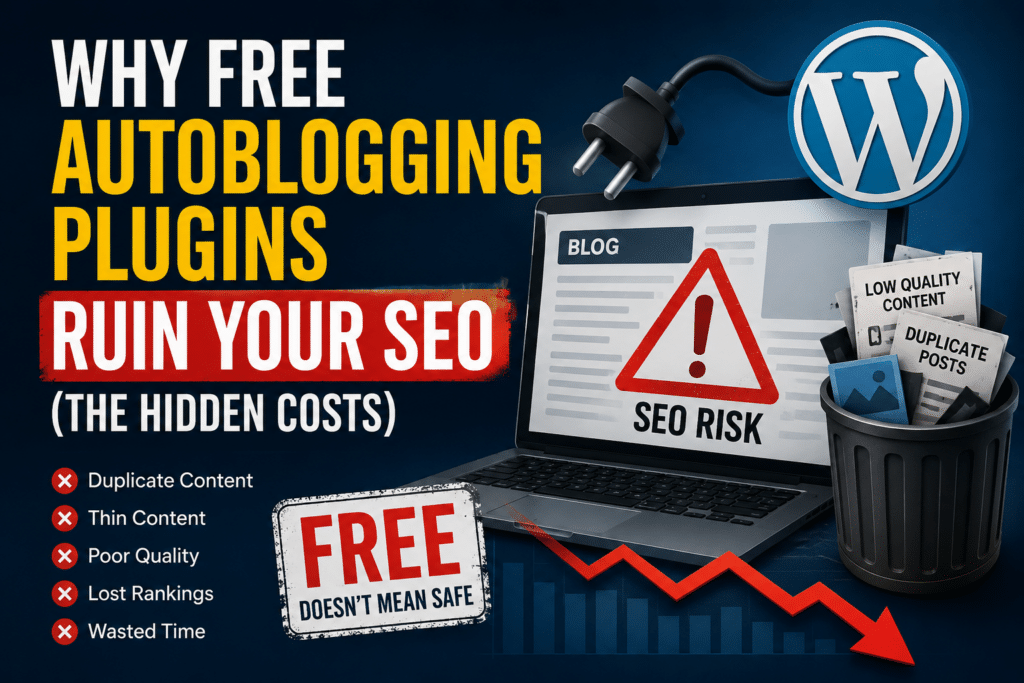
Free autoblogging plugins sound like an easy win.
Install a plugin, connect an RSS feed or AI tool, choose a schedule, and let WordPress publish articles while you focus on other parts of your business. For a new blogger, affiliate marketer, agency, or small business owner, that promise is understandably attractive.
Publishing consistently is difficult. Research takes time. Writing takes time. Formatting, images, SEO settings, internal links, and scheduling take even more time.
So when a free autoblogging plugin says it can fill your site with content automatically, it can feel like the fastest route to more traffic.
But there is an important difference between automating a useful content workflow and automating low-value publishing.
Free autoblogging tools are not automatically harmful. RSS aggregation can be useful for curated news pages. AI can help with research, outlining, formatting, and drafting. WordPress automation can save a huge amount of time.
The problem begins when a website publishes copied, thin, inaccurate, poorly structured, or repetitive content at scale without adding meaningful value for readers.
That is where the hidden SEO costs appear.
In this guide, we will explain why free autoblogging plugins can hurt your SEO, what risks to watch for, and how to build a smarter WP Auto Blog workflow that supports long-term growth instead of short-term content volume.
Why Free Autoblogging Plugins Are So Tempting
Most website owners do not install a free autoblogging plugin because they want poor-quality content.
They install one because they have a real business problem:
- Their blog has not been updated for months.
- They have a long list of keywords but no time to write.
- Their competitors publish more frequently.
- Their agency manages several client sites.
- They want to build a niche site without hiring a full-time writer.
- They need a way to turn ideas into publishable content faster.
Free plugins can appear to solve all of these challenges at once.
Many WordPress autoblogging tools offer features such as RSS feed imports, feed-to-post conversion, scheduled publishing, content scraping, keyword campaigns, and basic AI rewriting. The WordPress ecosystem includes many RSS aggregation and autoblogging options, including tools built around importing feeds and publishing them as posts.
The issue is not automation itself.
The issue is using automation as a substitute for originality, editorial judgment, and a real content strategy.
A website can publish 100 posts in a month and still fail to build traffic if those posts do not help users, answer search intent, or offer something different from what already exists online.
The Biggest Hidden Cost: Content That Adds No New Value
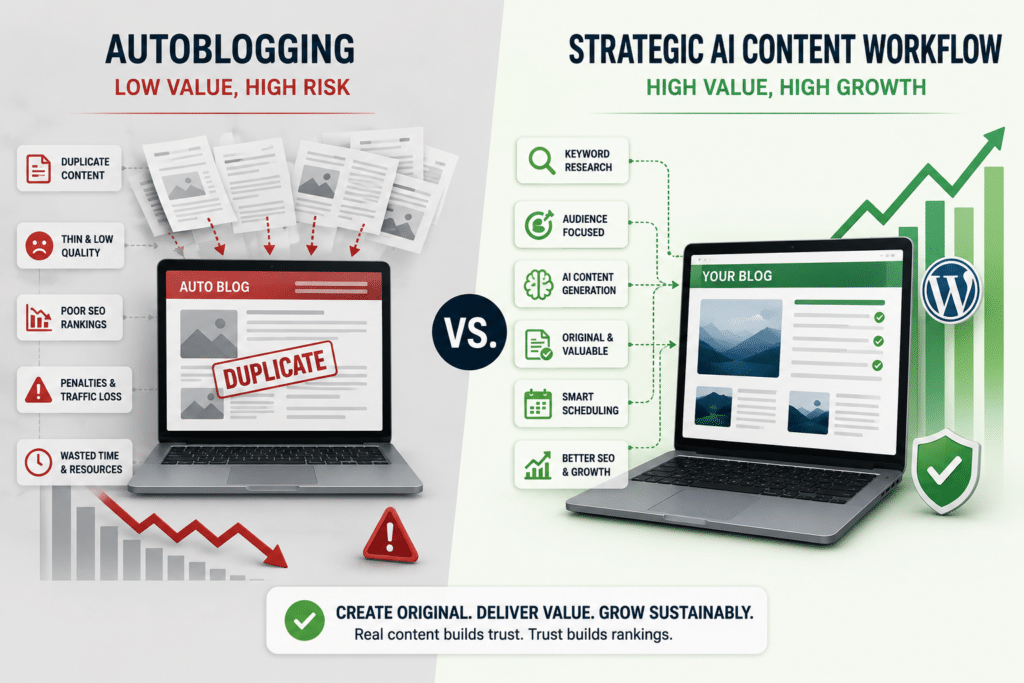
The most common free autoblogging workflow looks like this:
- Find an RSS feed.
- Import every new item automatically.
- Publish it as a WordPress post.
- Repeat this across multiple feeds.
- Hope that more pages lead to more Google traffic.
This approach creates volume, but volume is not the same as value.
If the imported post is substantially similar to the source article, readers have little reason to visit your website instead of the original publisher. If dozens of websites import the same feed, search engines also have little reason to prioritize every version.
A copied article may be indexed. It may even receive occasional traffic. But it is much harder to build durable rankings, trust, backlinks, and topical authority from content that is interchangeable with content available elsewhere.
Google’s current guidance is clear that using automation or generative AI to create many pages without adding value for users can violate its spam policies on scaled content abuse. Google also emphasizes accuracy, quality, and relevance—not simply whether a piece of content was made with AI.
That means the question is not:
“Is this post automated?”
The better question is:
“Would a reader find this post more useful than the other pages already available for this topic?”
If the answer is no, publishing more of those posts will not create a strong SEO foundation.
Hidden Cost #1: Duplicate and Near-Duplicate Content
RSS autoblogging often creates duplicate or near-duplicate pages.
A feed may provide the full article, a partial article, an excerpt, or a rewritten version. Even if a plugin changes a few words, adds an introduction, or rearranges paragraphs, the result may still be extremely similar to the original source and other syndicated copies.
This creates several problems.
Search Engines Must Choose a Version
When similar pages exist across multiple websites, search engines need to decide which version to show for a query.
The original publisher often has stronger signals:
- It published first.
- It has more authority.
- It has more backlinks.
- It has an established audience.
- It contains the complete original context.
Your imported copy may not be selected as the preferred result.
Your Own Website Can Become Repetitive
Duplicate content is not only an external issue.
A poorly configured free autoblogging plugin can publish similar posts across categories, tags, archives, and campaigns. Over time, your own website may contain dozens of pages that target almost the same keyword with almost the same angle.
This can confuse both readers and search engines about which page is the best resource.
Rewriting Is Not Always Originality
Some tools promote AI rewriting as a solution. But rewriting an article sentence by sentence does not automatically create original, helpful content.
Originality comes from adding something meaningful:
- Your own experience
- A new framework
- A better explanation
- Unique examples
- A comparison
- A checklist
- Current data
- A clear opinion supported by evidence
- A useful workflow for a specific audience
Simply changing wording is not the same as creating a better resource.
Hidden Cost #2: Thin Content at Scale
Free autoblogging plugins often have limits.
They may import only excerpts. They may not support advanced formatting. They may not create useful metadata. They may not include image controls, content quality checks, internal links, or detailed campaign settings.
As a result, many sites end up publishing posts that are:
- 150 to 300 words long
- Missing proper headings
- Missing featured images
- Filled with generic summaries
- Lacking a clear conclusion
- Missing author context
- Missing internal links
- Not optimized for the reader’s actual question
One thin post may not hurt a website. But hundreds of thin posts can make the entire site feel less useful.
This is especially damaging for a new site that is trying to establish authority.
Instead of building a focused library around a niche, the website becomes a collection of shallow pages with little connection between them.
A better WP AI workflow should help you create complete, structured articles around a defined content plan—not simply turn every feed item into a post.
Hidden Cost #3: Weak Search Intent Matching
A keyword is not a content strategy.
For example, someone searching for “best AI content plugins for WordPress agencies” is probably looking for:
- A comparison of suitable tools
- Agency-specific requirements
- Multi-site considerations
- Client workflow features
- Pricing considerations
- Content quality controls
- Practical recommendations
An imported RSS article about “AI trends in WordPress” may contain some related words, but it does not necessarily satisfy that search intent.
Free autoblogging plugins usually work from available feeds, not from a carefully planned search-intent map.
This can cause your site to publish content because it is easy to import, rather than because it is useful to rank for.
A stronger strategy starts with questions such as:
- What does the searcher want to accomplish?
- What stage of the buying journey are they in?
- What information is missing from current results?
- Which supporting articles should link to this page?
- What action should the reader take after reading?
This is where an AI Blogger workflow can be more useful than simple RSS importing. The goal should be to create content around audience needs and topic clusters, not around whatever happened to appear in a feed today.
Hidden Cost #4: No Brand Voice or Differentiation
If your site imports articles from ten different sources, the tone changes constantly.
One post may sound formal. Another may be casual. Another may be technical. Another may be written for a completely different audience.
That inconsistency makes it difficult to build a recognizable brand.
For a small business, agency, or SaaS product, your blog should reinforce your positioning. Your content should help readers understand:
- Who you serve
- What you believe
- What problems you solve
- Why your process is different
- What they should do next
RSS imports cannot reliably do that because they were written for someone else’s audience and someone else’s business goals.
A better approach is to define your site persona before generating content:
- Target audience
- Industry
- Tone
- Reading level
- Product positioning
- Core expertise
- Conversion goals
That gives every article a consistent voice and purpose.
For a deeper look at how WordPress content workflows are evolving, read WP AI Evolution: How Developers Use AI in 2026.
Hidden Cost #5: Poor Internal Linking
Internal links are one of the most overlooked parts of SEO content automation.
A good internal link helps readers discover the next relevant page. It also helps search engines understand how your content is organized.
For example, an article about free autoblogging plugins should naturally link to related pages such as:
- A guide to building a WP Auto Blog
- A comparison of WPAutoblog and Hero AI Blogger
- A guide to AI content workflows
- A pricing page for readers ready to choose a tool
Most free autoblogging plugins do not understand your content cluster. They import a post and publish it as a standalone page.
Over time, you end up with orphaned content: pages with few or no meaningful internal links.
This makes it harder for readers to navigate your site and harder for your best pages to pass relevance and authority to related content.
A content campaign should be planned as a connected system, not as a pile of individual posts.
If you are building that system, start with Build a High-Ranking WP Auto Blog in 2026.
Hidden Cost #6: Inaccurate, Outdated, or Unchecked Information
Automation increases publishing speed. It can also increase the speed at which mistakes are published.
An RSS source may contain outdated information. An AI-generated draft may make a factual mistake. A scraped article may reference an old product version, a discontinued feature, or an outdated price.
When a website publishes automatically without a review process, these issues can accumulate.
This is especially risky in topics involving:
- Finance
- Health
- Legal information
- Security
- Product pricing
- Software documentation
- Compliance
- Technical setup instructions
Even in lower-risk niches, inaccurate content damages reader trust.
A visitor who finds one misleading article may not return. A potential customer who notices outdated product information may decide your company is not reliable.
Automation should reduce repetitive work, not remove responsibility.
A smart publishing process includes quality controls such as:
- Topic approval
- Brand persona settings
- Clear content requirements
- Draft review for important pages
- Fact-checking where appropriate
- Scheduled content audits
- Updates for outdated articles
Hidden Cost #7: Bad User Experience and Broken Formatting
Many RSS feeds were not designed to become complete WordPress posts.
They may include broken formatting, incomplete images, missing captions, odd HTML, embedded content that does not load, or truncated paragraphs.
A free plugin may import the feed exactly as it appears.
The result can look automated in the worst possible way:
- Headlines without context
- Empty image areas
- Strange spacing
- Broken links
- Repeated source credits
- Incomplete paragraphs
- Generic excerpts
- No clear call to action
Readers notice this immediately.
Good content should be easy to scan. It should use headings, paragraphs, lists, images where useful, and a clear structure that helps someone find an answer quickly.
This is one reason native WordPress block assembly matters. Instead of pasting raw feed content into a post, an AI-powered workflow can create content in WordPress-ready sections such as headings, paragraphs, lists, FAQs, comparison tables, and image placements.
Hidden Cost #8: Publishing Too Much, Too Fast
A common mistake is launching a free autoblogging plugin and scheduling dozens of posts per day.
The logic is simple: more pages should mean more chances to rank.
But publishing 100 weak pages is not better than publishing 10 useful pages.
A sudden flood of low-quality content can make your site difficult to manage. It can also create a large cleanup project later when you realize that many pages have no traffic, no backlinks, no conversions, and no clear purpose.
A sustainable content schedule is usually better:
- Publish consistently.
- Focus on topics that matter to your audience.
- Build clusters instead of random pages.
- Review performance.
- Improve posts that show early potential.
- Remove or consolidate pages that do not add value.
Hero AI Blogger is designed around campaigns and drip-feed scheduling so you can plan content around target keywords and publish on a steady cadence rather than dumping everything online at once.
Free Does Not Mean Bad—But It Often Means You Must Do More Work
It is important to be fair: a free autoblogging plugin is not automatically a bad choice.
Free tools can be useful when you need to:
- Display a curated list of industry headlines
- Build a news aggregation page
- Show excerpts with clear source attribution
- Create a resource hub
- Test a workflow before upgrading
- Import content as drafts for manual editing
RSS aggregation can be valuable when the goal is curation.
The SEO problem appears when curation is presented as original publishing, or when imported content is treated as a replacement for a real content strategy.
The “free” cost is often paid in other ways:
- More manual cleanup later
- More time fixing formatting
- More time checking facts
- More time removing duplicate pages
- Lower conversion rates
- Weak brand trust
- Lost opportunity to build authority
A free tool may save money today while creating a much larger content debt tomorrow.
A Better Alternative: Automate the Process, Not the Shortcut
The best content automation does not mean “publish anything without review.”
It means automating the repetitive parts of a high-quality process.
A strong AI content workflow can include:
- Keyword-based campaigns
Start with topics your audience actually searches for. - A defined site persona
Give the system your audience, brand voice, business purpose, and tone. - Original article generation
Create a new resource instead of importing someone else’s work. - WordPress-ready structure
Build posts using headings, paragraphs, lists, tables, and media placements. - Smart scheduling
Publish consistently over days or weeks. - Featured image automation
Add relevant visuals without spending time searching for every image manually. - SEO-aware formatting
Use clear titles, logical headings, readable sections, and relevant internal links. - Human review where it matters
Review high-value commercial pages, sensitive topics, and important brand content.
This is the difference between an automated content machine and a content strategy.
How Hero AI Blogger Helps You Avoid the Common Risks
Hero AI Blogger was built for WordPress users who want consistent publishing without relying on copied RSS content.
Instead of importing articles from other websites, Hero AI Blogger helps you create campaigns around your own target keywords.
You configure your site purpose, audience, and tone. Then you choose the number of posts and publishing schedule. The system generates, formats, and publishes WordPress-ready content in the background.
This approach helps you focus on the parts that matter:
- Building topical authority
- Publishing original content
- Maintaining a consistent voice
- Creating a realistic schedule
- Growing a useful blog over time
It also includes automatic featured images and supports campaigns designed for niche site builders, agencies, small businesses, and busy bloggers.
You can compare this approach with other automation workflows in WPAutoblog vs Hero AI Blogger: 2026 Review.
Final Thoughts: The Real Cost of Cheap Content
Free autoblogging plugins are not the enemy.
Poor content strategy is.
If you use a free tool to curate sources transparently, create drafts for review, or support a useful resource page, it can be a practical part of your workflow.
But if you use automation to publish copied, thin, repetitive, or unhelpful content at scale, the hidden cost can be much higher than the price of a premium tool.
You may lose time cleaning up pages. You may struggle to build trust. You may miss the opportunity to create content that actually brings qualified visitors to your business.
The better path is to automate responsibly.
Build content around real audience questions. Add a clear point of view. Use a consistent brand voice. Publish on a schedule you can maintain. Create useful internal links. Review important content. Focus on quality before quantity.
Hero AI Blogger helps you do exactly that—turning content automation into a structured, original, WordPress-native publishing workflow.
Ready to move beyond low-value RSS imports?
Explore Hero AI Blogger Pricing and start with 20,000 free monthly tokens.
Try Hero AI Blogger Free on WordPress.org
Start with the free Hero AI Blogger plugin for WordPress and get 20,000 free monthly tokens every month, no credit card required.
Create your first keyword campaign, choose a publishing schedule, and see how an original-content workflow fits your site.
Need more tokens, longer articles, more sites, or advanced publishing capacity? Explore Hero AI Blogger Pricing.
Get Practical WP AI Growth Tips
Receive occasional WordPress automation, AI content, and SEO tips for bloggers, agencies, and site builders.
No spam. Unsubscribe anytime.