Artificial intelligence has completely rewritten the playbook for search engine optimization. If you are still manually drafting individual articles, you are competing against agencies and publishers who are deploying thousands of hyper-optimized pages with a single click. In 2026, the discussion is no longer about whether you should use an automated WordPress blog, but how you architect it to ensure it actually ranks and drives meaningful conversions.
The strategy behind automated blogging has matured significantly over the last few years. Modern SEO demands much more than simply spinning text or generating generic, low-effort articles. To win the organic traffic game today, it requires sophisticated programmatic SEO, advanced internal linking structures, and strict adherence to Google’s evolving E-E-A-T 2.0 (Experience, Expertise, Authoritativeness, and Trustworthiness) signals.
If you want to scale your content pipeline without sacrificing quality or risking manual penalties, here is the definitive, step-by-step developer blueprint for building a high-ranking wp auto blog in 2026.
1. The Anatomy of a 2026 Auto Blog: Moving Beyond Spun Content
In the past, autoblogging meant scraping RSS feeds or dumping a massive wall of low-quality AI text onto a page and hoping for the best. Today, Google’s algorithms are incredibly sophisticated and can easily identify pages offering minimal unique value. A high-ranking auto blog in 2026 operates on the strict principles of Programmatic SEO.
Programmatic SEO is the practice of using automation, dynamic templates, and structured data to generate a large number of web pages, each designed to rank for specific long-tail search queries.
The Core Difference: Intent Over Volume
Rather than trying to rank for a single, highly competitive head term (which requires massive backlink profiles and years of effort), programmatic SEO solves two distinct problems at once:
- Hyper-Targeted Content: It allows you to match long-tail keywords and user intent with pages that feel entirely custom-made for the reader.
- Massive Organic Reach: It expands your site’s overall footprint by targeting thousands of related keywords simultaneously.
Instead of fighting over the broad keywords that Google’s AI Overviews are already answering directly in the search results, you capture highly qualified traffic by being the most relevant answer for ten thousand different, hyper-specific questions.
2. Setting Up the Modern Technical Stack
You absolutely cannot build a high-performance automated engine on a cheap, shared hosting plan. When you scale a website from 50 pages to 5,000 pages, the sheer volume of database queries (wp_postmeta lookups, taxonomy routing, etc.) requires a robust, scalable infrastructure.
The Content Management System (CMS)
- WordPress: WordPress remains the absolute gold standard for this architecture, currently powering over 40% of all websites globally. Its REST API and massive plugin ecosystem make it the perfect foundation for automated content generation.
- Data Sources: Your content needs a structured database to pull from. This can be Google Sheets, Airtable, or a structured CSV file where every single row represents one uniquely generated page.
The Automation and Import Layer
You need dedicated tools that seamlessly connect your external data to your WordPress custom fields and templates.
- WP All Import: Often considered the “Swiss Army Knife” for programmatic SEO on WordPress, this plugin automates processes by uploading pages and mapping complex data fields at massive scale.
- Advanced Auto-Publishers: Modern auto-publishing workflows in 2026 cover the full path from opportunity to live URL. They handle the formatting, keyword mapping, internal linking, and auto-scheduling.
The Technical SEO Framework
Your auto blog must output perfect metadata and schema markup without manual intervention.
- Modern SEO Plugins: Tools like DefiniteSEO or Rank Math are leading the charge in 2026. DefiniteSEO utilizes an AI backbone to auto-generate complex schema markup and EEAT signals based on the site’s data. Meanwhile, the 2026 version of Rank Math excels with built-in AI keyword tracking and over 40 distinct schema types.
3. Designing the Programmatic SEO Architecture
To rank highly and avoid Google’s “Helpful Content” filters, your automated pages must provide genuine, tangible value beyond simple variable substitution. You achieve this by designing a flawless, dynamic page template.
Building the Keyword Matrix
Before you generate a single page, you must build a comprehensive keyword matrix. This involves combining broad “Head Terms” (high-volume keywords) with specific “Modifiers” (details that narrow down the search intent).
For example, if you are building an automated directory or resource hub for CRM software, your programmatic matrix might look like this:
| Head Term | Modifier 1 (Industry) | Modifier 2 (Use Case) | Modifier 3 (Size) |
| CRM | Real estate | Lead tracking | Small business |
| CRM | Healthcare | Pipeline management | Enterprise |
| CRM | Consulting | Contact management | Startup |
Architecting the Page Template
Your WordPress template needs to perfectly balance consistency (so it can scale across thousands of variations) with deep uniqueness (to provide real SEO value). Effective 2026 templates must include:
- Dynamic title tags and meta descriptions that pull directly from the dataset.
- Unique
H1tags incorporating the exact target keyword string. - 2 to 3 paragraphs of highly variable, AI-enriched content.
- Data visualizations or dynamic comparison tables built using Gutenberg blocks.
- Clear, contextually relevant Calls to Action (CTAs).
To strictly avoid duplicate content flags and index bloat, you must include differentiation elements on every generated page. This means utilizing unique images, scraping or generating user reviews relevant to that specific variation, and embedding FAQ sections with page-specific questions.
4. Integrating Agentic AI for Content Enrichment
This is where artificial intelligence truly transforms the autoblogging landscape. Rather than relying on generic placeholder text or outdated article spinners, you can now generate highly unique, contextually brilliant content for each page variation.
The Deep Data Enrichment Workflow
If you are managing your keywords in a spreadsheet or database, you can connect it directly to an AI API (like OpenAI’s Davinci model or Google’s Gemini) to enrich your content automatically before it ever hits WordPress.
- Set up the Foundation: Place your target variables (Industry, Location, Feature) into Airtable or Google Sheets.
- Call the AI via API: Use webhook integrations, tools like Data Fetcher, or custom Google App Scripts to securely call the OpenAI API, passing your specific row variables as complex prompts.
- Generate Output: Instruct the AI to act as an expert copywriter and generate unique product descriptions, customized benefits, and localized FAQ answers for each specific database row.
- Sync to WordPress: Push this heavily enriched text data directly into your WordPress custom fields (ACF) or Gutenberg block patterns.
By 2026, the absolute best SEO teams operate exclusively with these AI-supported workflows, allowing their technical stack to take over routine, mind-numbing tasks so the team can focus on overarching strategy.
5. The Crucial Role of Internal Linking & Semantic Silos
Generating 10,000 pages of beautifully formatted content means absolutely nothing if Google’s crawlers cannot find them or understand how they relate to one another. The most important feature for a scalable SEO operation is not just the AI writing; it is the system’s ability to logically connect the new article to the rest of the site’s architecture.
The Hub and Spoke Model
You must architect strict internal linking silos. Your main “Hub” page (for example, the parent page targeting “Best Tools”) must dynamically and automatically link out to all of the highly specific “Spoke” pages (such as “Best Tools for [Specific Niche]”).
Internal linking automation ensures that each newly generated post actively supports and passes PageRank to relevant existing pages, rather than floating aimlessly as an orphan URL. This semantic structuring matters deeply for sitewide crawlability, the efficient distribution of link equity, and establishing undeniable topical authority in the eyes of search algorithms.
6. E-E-A-T 2.0: Humanizing the Automated Machine
In 2026, search engines are ruthlessly focused on trust. AI-generated texts that lack a real human signature or verifiable sources will simply lose credibility and plummet in the rankings. Google actively identifies and connects authors, brands, and topics as unified entities and evaluates them for consistency.
To build a robust E-E-A-T 2.0 (Experience, Expertise, Authoritativeness, Trustworthiness) profile into your automated strategy, you must seamlessly blend AI efficiency with verified human trust signals:
- Structured Author Profiles: Ensure your automated posts are attributed to distinct, dedicated personas. These profiles must feature a realistic bio, a clear photo, verifiable background information, and proper
Schema.orgPerson markup injected into the page header. - Calibrated Tone of Voice: Configure your overarching AI system prompts to ensure the output remains honest, technically precise, and actively avoids sounding overly promotional or robotic.
- Mandatory Human Review for YMYL: If your auto blog touches on Your Money or Your Life (YMYL) subjects—such as legal advice, medical information, financial strategies, or reputation-sensitive topics—you must integrate a mandatory human review layer before hitting the final publish button.
7. API Token Optimization and Fail-Safe Mechanisms
- When running a high-volume wp auto blog, your external AI API connections (like OpenAI or Gemini) are the literal lifeblood of your content pipeline. If your system is executing hundreds of automated page generations simultaneously, managing your API token limits and monitoring for server-side rate limits becomes a critical technical necessity.
- Most basic auto-blogging setups fail because they lack error-handling protocols. If your site triggers an HTTP 429 error (Too Many Requests) from an API provider, a standard script will break mid-execution, leaving behind half-baked drafts, broken layout strings, or corrupted database entries in your
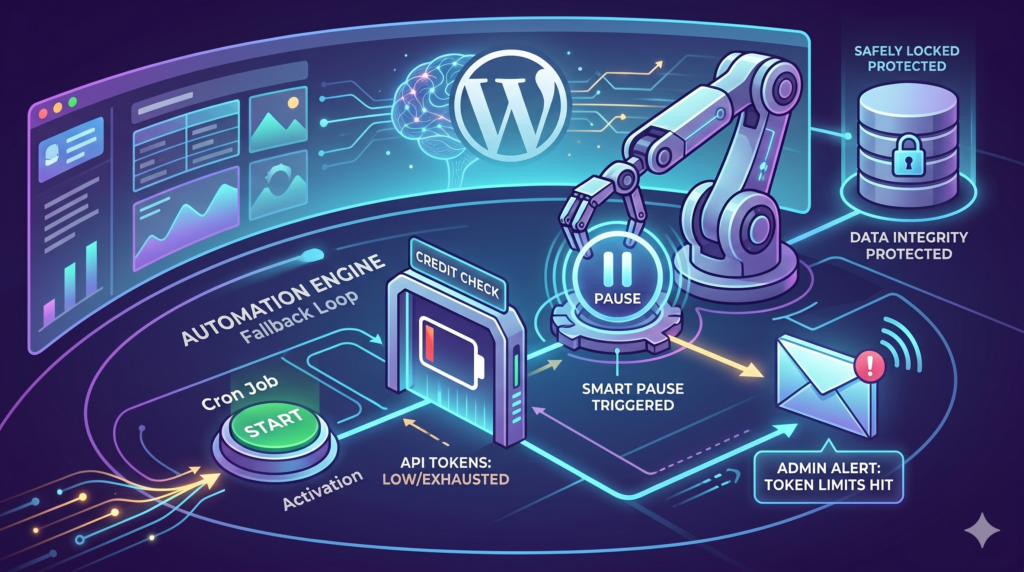
wp_poststable. - To prevent this, a professional programmatic setup utilizes a token optimization layer directly within WordPress. Tools like Hero AI Blogger run a pre-flight token check before initiating any bulk publishing queue. The system calculates the estimated token weight of the target keyword cluster against your remaining API balance.
- If it detects an imminent limit breach, the system triggers a “Smart Pause”—safely caching the current generation state in a secure WordPress transient, halting the automated cron job, and alerting the administrator. This fail-safe architecture ensures that your automated blog continues to scale smoothly without wasting API credits, bloating your server error logs, or causing unexpected script timeouts.
8. Advanced Technical Safeguards: Launching Safely at Scale
The single biggest mistake developers and agencies make when utilizing programmatic SEO is hitting “publish” on 10,000 pages all at once at 2:00 AM. Spiking your server load and flooding the Google index overnight looks highly suspicious and often results in algorithmic suppression.
If your automated template is bloated with heavy, unoptimized scripts or lacks strict quality control, your rankings will inevitably tank.
Scaling in Calculated Batches
To successfully execute a massive automated content campaign, you must implement a carefully staged rollout:
- Weeks 1 to 2: Publish an initial batch of 50 to 100 test pages to establish a baseline.
- Weeks 3 to 4: Closely monitor your indexing rates and crawl errors inside the Google Search Console.
- Weeks 5 to 6: Analyze the initial performance data, organic impressions, and user bounce rates.
- Weeks 7 and Beyond: Only scale up to full, high-volume deployment once the foundation metrics prove the template is healthy.
Mastering Core Web Vitals
Mobile-first indexing is no longer a suggestion; it is the mandatory standard. You must ensure your automated page templates easily pass Google’s Core Web Vitals tests. If the page is slow to render on a mobile device, or if it suffers from a high Cumulative Layout Shift (CLS) due to lazy-loaded images pushing text around, the page simply will not rank, regardless of how meticulously optimized the data and keywords are.
9. Managing Index Bloat and the Crawl Budget Bottleneck
By 2026, programmatic SEO isn’t just about generating thousands of pages—it’s about ensuring those pages actually get indexed and rank. One of the most severe technical risks when scaling an automated WordPress site is index bloat. Index bloat occurs when search engines index dozens, hundreds, or thousands of unnecessary or low-quality pages.
Without a deliberate indexing strategy, even the most data-rich site can drown in crawl waste. When search crawlers spend too much time navigating through low-value variations, they ignore the important, revenue-generating pages on your site. This not only wastes your crawl budget but can negatively affect your overall rankings and create a poor user experience.
To survive the indexing bottleneck in 2026, developers must implement strict protocols:
The 85% Index Coverage Rule
Search engines now prioritize quality over quantity and have deployed aggressive de-duplication filters to combat AI spam. You must actively monitor your Index Coverage ratio inside Google Search Console. A healthy ratio for programmatic sites is above 85% within 30 days of submission.
If you measure the percentage of indexed URLs that generate zero organic clicks over a 90-day period and find it exceeds 30%, you are suffering from index bloat. Those pages are dragging down your site’s overall authority and must be pruned, consolidated, or hit with a noindex tag.
Dynamic Sitemaps and Tiered Internal Linking
Sitemaps are no longer a simple, static list of URLs. In 2026, you need to implement a dynamic XML sitemap strategy. This involves segmenting sitemaps by content type and configuring your WordPress SEO plugin to automatically exclude low-quality pages, duplicate URLs, or pages returning soft 404s.
Furthermore, if you are seeing massive spikes in “Crawled – currently not indexed” errors, the solution is almost always a tiered internal linking structure. Top category (pillar) pages must link to subcategory (cluster) pages, which seamlessly link down to the individual programmatic pages. By structuring your automated WordPress blog this way, you ensure maximum crawl efficiency and rapid indexation for your most valuable content.
Conclusion: The Era of Smart Automation
Building a high-ranking wp auto blog in 2026 is an intricate exercise in data structuring, dynamic template design, and precise technical execution. It is no longer a lazy shortcut to spam search engines; it is a highly technical, programmatic approach designed to answer thousands of specific user queries instantaneously.
By leveraging advanced automation plugins, strict internal linking frameworks, enriched dynamic data, and a commitment to E-E-A-T signals, developers can build a massive, authoritative organic footprint. This modern approach to autoblogging continuously drives targeted traffic, captures high-intent leads, and generates software sign-ups—all on complete, scalable autopilot. can grab the free core plugin from WordPress.org, or unlock the full automated growth engine by checking out our Premium Plans.
Try Hero AI Blogger Free on WordPress.org
Start with the free Hero AI Blogger plugin for WordPress and get 20,000 free monthly tokens every month, no credit card required.
Create your first keyword campaign, choose a publishing schedule, and see how an original-content workflow fits your site.
Need more tokens, longer articles, more sites, or advanced publishing capacity? Explore Hero AI Blogger Pricing.
Get Practical WP AI Growth Tips
Receive occasional WordPress automation, AI content, and SEO tips for bloggers, agencies, and site builders.
No spam. Unsubscribe anytime.