Every time Google announces a major algorithm update, website owners ask the same question:
“Will my rankings survive?”
It’s an understandable concern.
Search engines continue evolving to better understand search intent, evaluate content quality, and reward websites that genuinely help users.
For many WordPress site owners, this uncertainty becomes even greater when artificial intelligence enters the conversation.
Can AI-generated content rank?
Will automated publishing trigger penalties?
How do you continue scaling content without sacrificing long-term SEO?
Fortunately, the answer isn’t about avoiding AI.
It’s about using AI responsibly.
Google has repeatedly emphasized that it evaluates the quality and usefulness of content—not simply how it was created.
Whether an article is written entirely by a human, assisted by AI, or produced through an intelligent publishing workflow, the same principles apply:
- Does it help the reader?
- Is it original?
- Does it satisfy search intent?
- Is it well organized?
- Does it demonstrate expertise and trustworthiness?
These questions matter far more than whether AI participated in the writing process.
The challenge for modern publishers isn’t deciding whether to use AI.
It’s designing a publishing workflow that consistently produces valuable, trustworthy content.
In this guide, you’ll learn practical strategies for future-proofing your WordPress blog against Google algorithm updates, building stronger topical authority, and using AI automation in ways that support long-term organic growth rather than chasing short-term rankings.
Why Google Algorithm Updates Concern Website Owners
Google makes thousands of improvements to its search systems every year.
Most go unnoticed.
Others significantly change how websites perform in search results.
Major updates often introduce new ways of evaluating content quality, page experience, spam prevention, or user intent.
When rankings fluctuate, it’s tempting to search for shortcuts or assume that a particular tool caused the problem.
In reality, algorithm updates rarely target individual technologies.
Instead, they reward websites that consistently provide the best answers for users.
That means websites built around helpful content, clear organization, and genuine expertise are generally more resilient than sites relying on shortcuts or repetitive content.
Rather than asking:
“How can I avoid the next update?”
A better question is:
“How can I build a website that deserves to rank regardless of future updates?”
That shift in mindset forms the foundation of sustainable SEO.
What Google Actually Rewards
There are countless theories about ranking factors.
Some focus on keywords.
Others emphasize backlinks or technical optimization.
While these elements certainly matter, Google’s broader direction has remained remarkably consistent.
Search is increasingly designed to reward content that demonstrates value.
Characteristics of high-quality content include:
- Clear answers to user questions
- Original insights and examples
- Logical organization
- Strong readability
- Accurate information
- Helpful visuals where appropriate
- Internal links that improve navigation
- Content that satisfies search intent
In other words, Google is becoming better at measuring whether readers actually benefit from a page.
This is one reason why simply publishing hundreds of AI-generated articles rarely produces lasting success.
Quantity alone doesn’t create authority.
Helpfulness does.
If you’re building an automated publishing workflow, it’s worth remembering that automation should support these quality signals—not replace them.
AI Isn’t the Problem—Poor Content Is
One of the biggest misconceptions surrounding AI is that search engines automatically penalize AI-generated content.
Google has never said that.
Instead, its guidance consistently focuses on the usefulness and originality of the final content.
Poor content written by humans can perform badly.
Poor content generated by AI can perform badly.
Likewise, well-researched, well-structured, and genuinely helpful content can succeed regardless of whether AI assisted in the writing process.
This distinction is important.
AI should be viewed as a productivity tool rather than a shortcut to rankings.
When used responsibly, it can help publishers:
- Research topics more efficiently
- Organize complex information
- Maintain consistent publishing schedules
- Improve article structure
- Generate metadata
- Identify content opportunities
However, AI still depends on the strategy guiding it.
Without clear goals and editorial oversight, automation simply produces more content—not necessarily better content.
Building Topical Authority Instead of Chasing Keywords
Many websites still focus on ranking individual articles for isolated keywords.
While that approach occasionally works, modern SEO increasingly rewards websites that demonstrate expertise across an entire subject.
This concept is often called topical authority.
Instead of publishing unrelated posts whenever a new keyword appears, successful websites create groups of connected articles that explore a topic from multiple perspectives.
For example, a WordPress AI website might publish content covering:
- AI content automation
- WordPress SEO
- Topic clusters
- Publishing workflows
- Content strategy
- Cron scheduling
- Internal linking
- AI-assisted blogging
Together, these articles create a stronger signal of expertise than any single page could achieve on its own.
Internal linking reinforces those relationships while helping readers discover additional resources naturally.
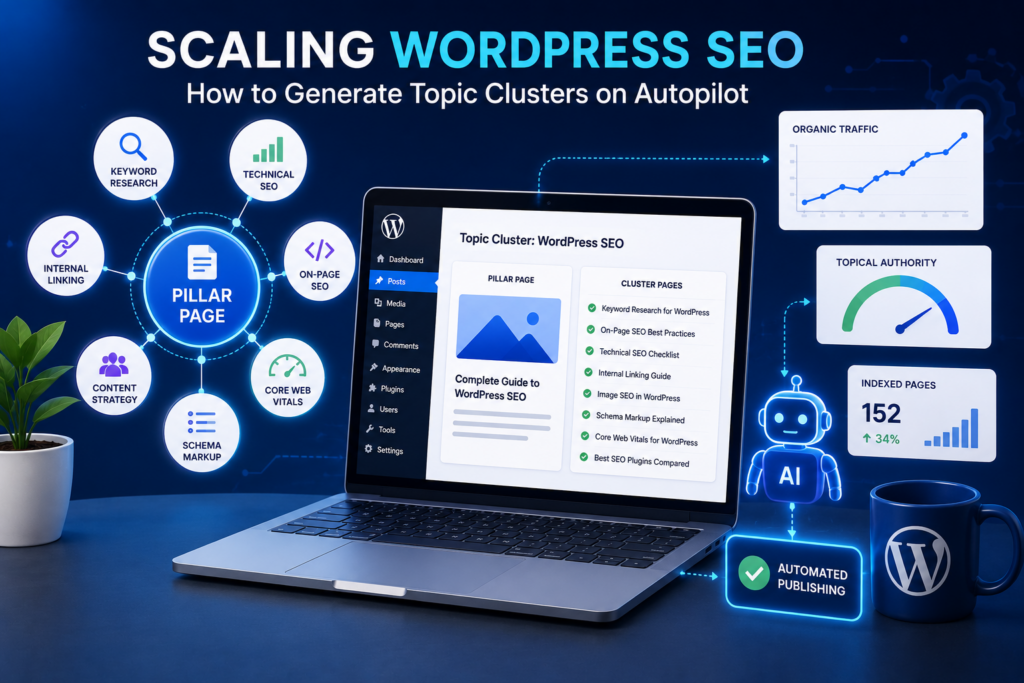
Our article on Scaling WordPress SEO: How to Generate Topic Clusters on Autopilot explains how building connected content clusters strengthens both user experience and long-term search visibility.
Likewise, WP AI: The Evolution of Intelligent Content Automation for WordPress in 2026 explores how AI is evolving beyond simple writing assistants into complete publishing systems that support sustainable SEO strategies.
Rather than chasing every trending keyword, focus on becoming one of the most useful resources within your chosen niche.
That approach remains effective regardless of how Google’s algorithms evolve.
Why Semantic Structure Matters More Than Ever
Modern search engines don’t simply read words.
They interpret relationships.
Clear page structure helps search engines understand how information is organized and how different sections connect.
Well-structured articles typically include:
- One descriptive H1 heading
- Logical H2 and H3 sections
- Short paragraphs
- Numbered and bulleted lists
- Relevant images with descriptive alt text
- Frequently asked questions
- Internal links to related resources
This isn’t about manipulating algorithms.
It’s about improving readability for real people.
WordPress’s block editor naturally supports this type of semantic organization by encouraging content to be divided into meaningful sections rather than long, unstructured walls of text.
As you’ll see in the next section, modern AI publishing platforms can also take advantage of this block-based architecture to produce content that’s easier to edit, easier to read, and better aligned with WordPress best practices.
Semantic HTML and Native WordPress Blocks
One of the most overlooked aspects of SEO is how content is structured in the underlying HTML.
Readers see headings, paragraphs, images, and buttons.
Search engines see semantic elements that help them understand the purpose and hierarchy of each section.
This is where WordPress excels.
The Gutenberg editor creates content using structured blocks instead of a single, unformatted body of text.
When used correctly, this results in cleaner HTML, better accessibility, and a more consistent reading experience.
A well-structured article should typically include:
- A single H1 heading
- Logical H2 and H3 subheadings
- Short paragraphs
- Ordered and unordered lists
- Images with descriptive alt text
- Tables where appropriate
- FAQ sections
- Internal links to supporting articles
- Clear calls to action
These elements don’t guarantee rankings, but they help search engines understand your content while making it easier for visitors to consume.
Instead of viewing SEO as a collection of tricks, think of semantic structure as good website architecture.
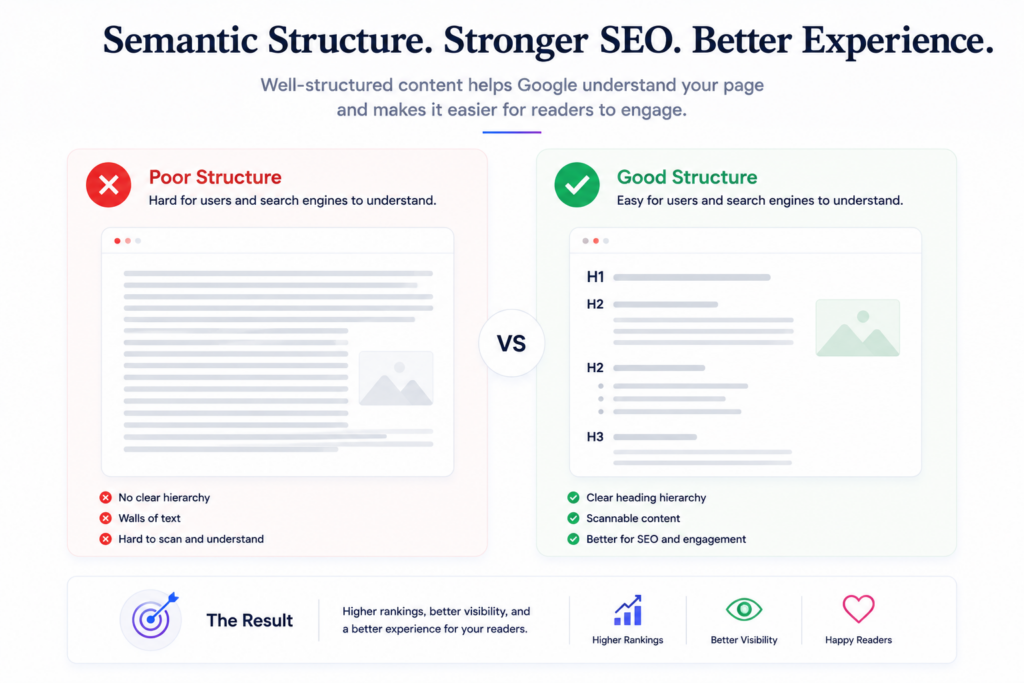
The better organized your content is, the easier it becomes for both users and search engines to navigate.
Why Consistency Matters More Than Publishing Speed
Many website owners assume publishing more articles automatically leads to more traffic.
In practice, consistency usually outperforms bursts of activity.
Publishing twenty articles in one week followed by two months of silence sends a different signal than publishing one high-quality article every week throughout the year.
Consistency offers several long-term advantages:
- Readers know when to expect new content.
- Search engines discover fresh pages more regularly.
- Internal linking opportunities increase naturally.
- Topic clusters develop steadily over time.
- Content quality remains easier to maintain.
Automation can make this process significantly easier.
Instead of trying to remember publishing schedules manually, campaign-based workflows allow content to be generated and published according to a predefined plan.
If you’re interested in building a sustainable publishing workflow, our guide Build a High-Ranking WP Auto Blog in 2026 explains how consistent automation supports long-term organic growth without sacrificing quality.
How Hero AI Blogger Supports Future-Proof Publishing
Hero AI Blogger was built with the idea that automation should improve publishing quality rather than simply increase publishing speed.
Instead of acting as another AI writing assistant, it focuses on automating the complete WordPress publishing workflow.
Depending on your campaign settings, Hero AI Blogger can help automate:
- Keyword-focused content generation
- Native WordPress block formatting
- SEO titles and meta descriptions
- Featured image selection
- Publishing schedules
- Brand voice customization
- Campaign-based content planning
This workflow encourages websites to build structured, interconnected content instead of isolated articles.
Because everything is created for WordPress from the beginning, editors spend less time fixing formatting issues and more time reviewing content strategy.
If you’re exploring how WordPress AI continues to evolve beyond simple prompt-based writing, our article WP AI: The Evolution of Intelligent Content Automation for WordPress in 2026 explains why intelligent automation is becoming the preferred approach for modern publishers.
Technical SEO Habits That Age Well
Algorithms change.
Good website practices rarely do.
Rather than chasing every SEO trend, focus on habits that consistently improve your website.
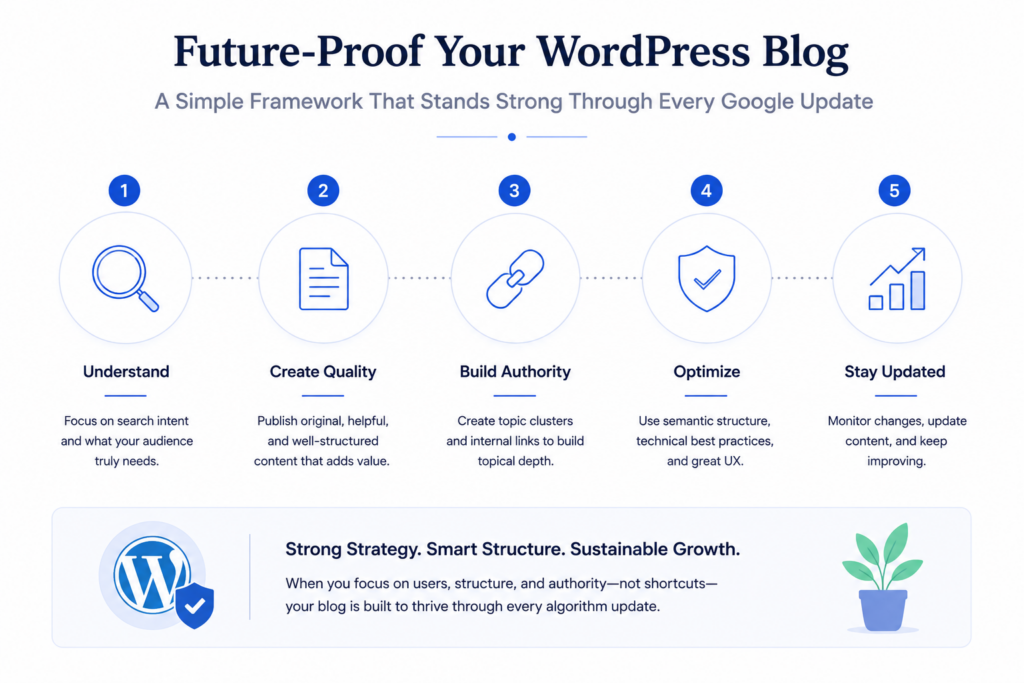
Some of the most valuable long-term practices include:
Publish for people first
Create content that genuinely answers questions instead of trying to satisfy search engines alone.
Build topic clusters
Connect related articles through thoughtful internal linking.
This helps readers explore your website while strengthening topical authority.
Keep content updated
Refreshing older articles is often just as valuable as publishing new ones.
Review statistics, screenshots, links, and recommendations periodically.
Improve page experience
Fast loading pages, responsive layouts, and accessible design improve usability regardless of future algorithm changes.
Use descriptive metadata
Titles, meta descriptions, image alt text, and headings all help search engines understand your content.
Avoid shortcut strategies
Techniques designed to manipulate rankings often stop working after major updates.
Building genuine authority takes longer, but it creates more sustainable results.
A Future-Proof WordPress SEO Checklist
Before publishing any article, ask yourself these questions:
✅ Does this content answer a real user question?
✅ Is it original rather than simply repeating existing articles?
✅ Is the page logically structured with headings and lists?
✅ Have I included helpful internal links?
✅ Are images relevant and properly optimized?
✅ Is the article easy to read on desktop and mobile?
✅ Does it contribute to my website’s overall topical authority?
✅ Would I be comfortable recommending this article to someone without mentioning search engines?
If the answer is “yes” to most of these questions, you’re already following many of the same principles that Google encourages through its ongoing algorithm improvements.
Final Thoughts
No one can predict exactly how Google Search will evolve over the next few years.
What we do know is that its direction has remained remarkably consistent.
Google continues rewarding websites that publish original, well-organized, and genuinely helpful content.
That makes future-proofing less about reacting to every algorithm update and more about building a strong publishing foundation.
Responsible AI, semantic WordPress structure, topical authority, and consistent publishing are not temporary SEO tactics.
They’re long-term publishing principles.
Whether you write every article manually or use intelligent automation to streamline your workflow, success still depends on creating content that earns your readers’ trust.
Build for people first.
Search visibility often follows.
Try Hero AI Blogger Free on WordPress.org
Start with the free Hero AI Blogger plugin for WordPress and get 20,000 free monthly tokens every month, no credit card required.
Create your first keyword campaign, choose a publishing schedule, and see how an original-content workflow fits your site.
Need more tokens, longer articles, more sites, or advanced publishing capacity? Explore Hero AI Blogger Pricing.
Get Practical WP AI Growth Tips
Receive occasional WordPress automation, AI content, and SEO tips for bloggers, agencies, and site builders.
No spam. Unsubscribe anytime.