Publishing more blog posts doesn’t automatically lead to better search rankings.
Many website owners assume that producing dozens—or even hundreds—of articles will naturally increase organic traffic. Unfortunately, search engines don’t reward content based on volume alone.
They reward expertise.
Today’s SEO landscape is increasingly focused on topical authority—how comprehensively your website covers a subject and how well related pages connect to one another.
This is where topic clusters become one of the most effective long-term SEO strategies.
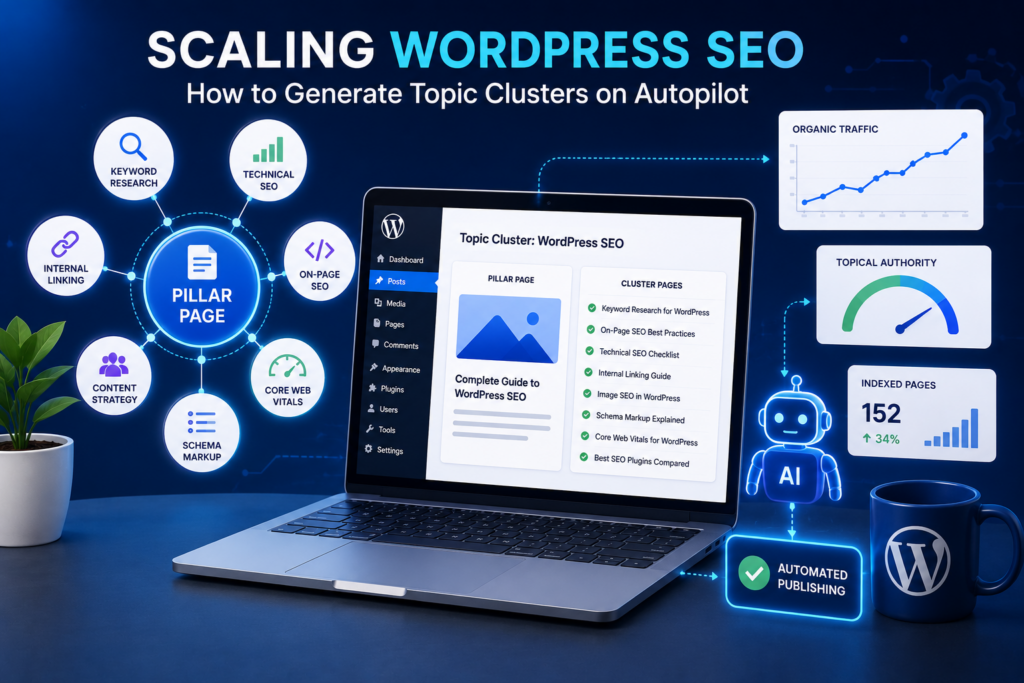
Instead of publishing isolated articles targeting random keywords, a topic cluster organizes multiple related posts around a central pillar topic. Each supporting article explores a specific subtopic while linking back to the main guide and to other relevant articles within the cluster.
The result is a stronger internal linking structure, better content organization, and clearer signals to search engines about your expertise.
The challenge, however, is scale.
Planning dozens of related topics, researching keywords, writing articles, scheduling publication, and maintaining consistency requires significant time and effort.
Fortunately, AI is changing how content teams approach this process.
Modern AI-powered WordPress tools can help generate topic ideas, build content clusters, create optimized articles, and publish them automatically according to a predefined schedule.
In this guide, you’ll learn what topic clusters are, why they matter for WordPress SEO, and how agencies, bloggers, and businesses can automate much of the process while maintaining high-quality content.
What Are Topic Clusters?
A topic cluster is a group of related articles built around a central subject.
At the center of the cluster is a comprehensive pillar page.
Supporting this page are multiple articles that each explore one specific aspect of the broader topic.
For example, imagine your website focuses on WordPress AI automation.
A pillar page might cover:
Complete Guide to WordPress AI Automation
Supporting articles could include:
- How AI Generates WordPress Blog Posts
- Best AI Plugins for WordPress
- Automating Content Scheduling
- AI SEO Best Practices
- WordPress Cron for AI Publishing
- AI vs Traditional Blogging
- Common AI Blogging Mistakes
- Measuring AI Content Performance
Every supporting article links back to the pillar page.
The pillar page links to every supporting article.
Relevant supporting articles also link to one another whenever appropriate.
This interconnected structure helps search engines understand the relationship between your content while making navigation easier for readers.
Instead of viewing each article independently, search engines recognize your website as a comprehensive resource on the broader topic.
Why Topic Clusters Matter for WordPress SEO
Search engines have become significantly better at understanding relationships between topics.
Rather than evaluating pages in isolation, modern algorithms analyze how well an entire website demonstrates expertise within a subject area.
Topic clusters support this goal in several ways.
Stronger Topical Authority
Publishing one article about WordPress SEO demonstrates knowledge.
Publishing twenty well-connected articles covering technical SEO, content strategy, internal linking, Core Web Vitals, schema markup, AI automation, and keyword research demonstrates expertise.
Topic clusters communicate depth rather than isolated knowledge.
Better Internal Linking
Internal links remain one of the simplest and most effective SEO techniques.
Topic clusters naturally create meaningful internal links between related articles.
These links help:
- distribute authority across your website
- improve crawlability
- reduce orphan pages
- keep visitors engaged longer
- guide users toward relevant content
Instead of adding links randomly, every internal link supports the overall content architecture.
Improved User Experience
Readers rarely stop after consuming a single article.
If someone searches for information about AI blogging, they may also want to learn about:
- SEO optimization
- publishing automation
- keyword research
- content planning
- AI workflows
Topic clusters make discovering related content effortless.
Visitors spend more time exploring your website because each article naturally leads to the next logical resource.
Easier Content Planning
Without a strategy, content calendars often become inconsistent.
Teams jump between unrelated topics depending on inspiration or current trends.
Topic clusters eliminate that problem.
Once the pillar topic is selected, supporting articles become much easier to plan because every piece contributes to a larger content strategy.
Instead of asking:
“What should we publish next?”
you simply ask:
“Which part of this topic haven’t we covered yet?”
The Biggest Challenge: Creating Topic Clusters at Scale
While the concept is straightforward, execution is often difficult.
Building a high-quality topic cluster requires more than writing several blog posts.
You need to:
- Research search intent.
- Identify supporting keywords.
- Avoid keyword cannibalization.
- Plan internal links.
- Maintain consistent formatting.
- Publish articles on a regular schedule.
- Update older content as new topics emerge.
Multiply this process across several clients or multiple niche websites, and content planning quickly becomes overwhelming.
This is why many agencies never fully implement topic clusters despite understanding their SEO value.
The workload simply becomes too large.
Fortunately, AI can automate much of the repetitive work without replacing human strategy.
In the next section, we’ll explore how AI helps generate topic clusters automatically, how Hero AI Blogger supports campaign-based content planning, and the best practices for building scalable WordPress SEO systems that continue growing over time.
How AI Makes Topic Cluster Creation Scalable
Creating one well-researched topic cluster manually is manageable.
Creating ten, twenty, or fifty topic clusters across multiple websites quickly becomes a full-time job.
This is where AI becomes a powerful productivity tool.
Rather than replacing SEO strategy, AI automates many of the repetitive tasks involved in content planning and publishing.
For example, AI can help:
- Generate dozens of related topic ideas from a single keyword.
- Organize topics into logical clusters.
- Suggest SEO-friendly headings.
- Create comprehensive article outlines.
- Write first drafts based on search intent.
- Recommend internal linking opportunities.
- Generate meta titles and descriptions.
- Schedule content for future publication.
Instead of spending hours brainstorming every article, content teams can focus on reviewing strategy, improving quality, and refining content for their audience.
The result is a faster, more consistent publishing workflow without sacrificing long-term SEO goals.
A Simple Workflow for Building Topic Clusters
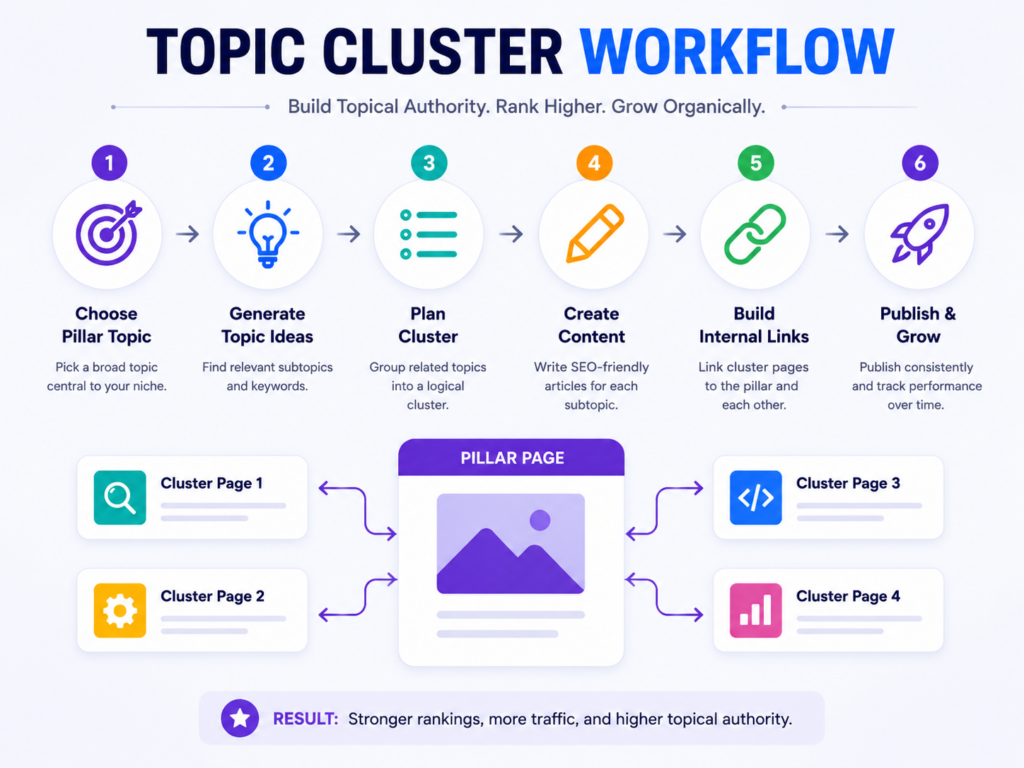
Whether you’re running a personal blog or managing dozens of client websites, a repeatable workflow makes scaling much easier.
Step 1: Choose Your Pillar Topic
Start with a broad subject that’s highly relevant to your business.
Examples include:
- WordPress SEO
- AI Blogging
- WordPress Security
- WooCommerce
- Local SEO
- Technical SEO
The pillar page should provide a comprehensive overview of the topic rather than trying to answer every possible question in detail.
Step 2: Identify Supporting Topics
Break the main topic into smaller subtopics that deserve their own dedicated articles.
For a pillar page about WordPress SEO, supporting articles might include:
- Keyword Research for WordPress
- Internal Linking Best Practices
- Image SEO Guide
- XML Sitemaps Explained
- Technical SEO Checklist
- AI Content Optimization
- Core Web Vitals
- Schema Markup
- SEO Plugins Comparison
- Topic Cluster Strategy
Each supporting article should answer one specific question in depth.
Step 3: Build Internal Links
Once your articles are planned, connect them logically.
Every supporting article should link back to the pillar page whenever appropriate.
Likewise, the pillar page should introduce readers to every supporting resource.
Relevant supporting articles should also reference each other where it improves the reader experience.
This creates a strong network of internal links that benefits both users and search engines.
Step 4: Publish Consistently
Publishing twenty articles in one day is rarely the best strategy.
Instead, spread your content over several weeks or months.
Consistent publishing helps maintain a steady flow of fresh content while giving search engines regular opportunities to discover new pages.
Automation makes this much easier.
How Hero AI Blogger Helps Automate Topic Clusters
At Hero AI Blogger, we designed campaigns specifically to reduce the repetitive work involved in content publishing.
Instead of generating articles one at a time, you can build keyword-driven publishing campaigns.
A typical workflow looks like this:
- Define your website’s audience and brand voice.
- Enter your primary keyword or topic.
- Configure how many articles you want to generate.
- Set your publishing schedule.
- Let the campaign automatically generate and publish content over time.
Rather than requiring you to return every day to create another post manually, the campaign continues executing in the background according to your chosen schedule.
Additional features that support scalable content publishing include:
- AI-generated WordPress-ready articles
- Automatic featured images
- SEO-friendly article structure
- Built-in scheduling
- WordPress Cron integration
- Custom site personas
- Multi-site support on higher plans
This campaign-based approach allows agencies, businesses, and niche site builders to maintain a consistent publishing schedule while spending more time on content strategy instead of repetitive production tasks. If you’re just getting started with automated publishing, our guide on Build a High-Ranking WP Auto Blog in 2026 walks through the complete setup process—from creating your first campaign to building a sustainable AI-powered publishing workflow.
Common Topic Cluster Mistakes
Even experienced marketers occasionally make mistakes when implementing topic clusters.
Avoid these common issues.
Publishing Unrelated Articles
Every article inside a cluster should reinforce the main topic.
Adding unrelated content weakens topical relevance and makes internal linking less effective.
Targeting the Same Keyword Repeatedly
If several articles compete for the same search intent, they may begin competing against each other.
This is known as keyword cannibalization.
Each supporting article should target a distinct question or keyword.
Weak Internal Linking
Topic clusters depend on strong internal connections.
Articles that aren’t linked together lose much of the structural advantage that clusters provide.
Review your internal links regularly as new content is published.
Ignoring Existing Content
Many websites already have dozens of useful articles.
Before creating entirely new content, review older posts that could be updated and incorporated into a topic cluster.
This often produces faster SEO improvements than starting from scratch.
Measuring the Success of Topic Clusters
Publishing a topic cluster is only the beginning.
Monitor performance over time to understand what’s working.
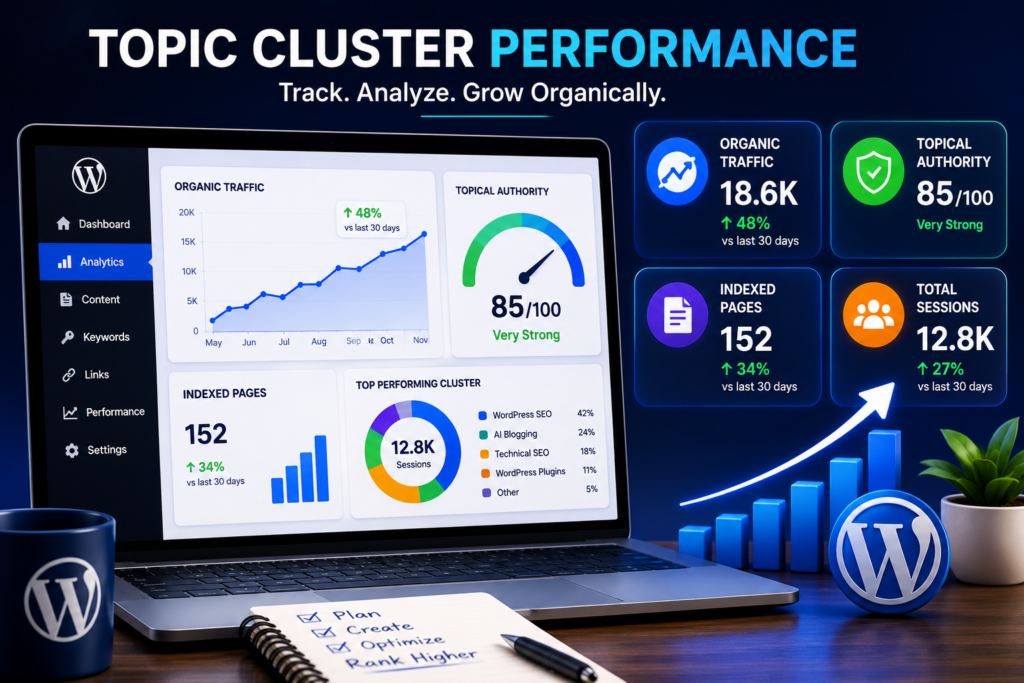
Useful metrics include:
- Organic traffic
- Search rankings
- Indexed pages
- Internal link growth
- Average engagement time
- Click-through rate
- Conversions
- Returning visitors
Remember that topic clusters are a long-term SEO strategy.
It often takes several months before search engines fully understand the relationships between your pages and reward your website with stronger rankings.
Consistency is far more important than immediate results.
Frequently Asked Questions
Final Thoughts
Scaling WordPress SEO isn’t about publishing as many articles as possible.
It’s about publishing the right articles in a structured, connected way.
Topic clusters help search engines understand your expertise while guiding readers through related content that answers their questions.
AI makes this strategy easier to execute by reducing the time spent on planning, drafting, formatting, and scheduling content.
Instead of treating every article as a separate project, you can build interconnected content systems that continue growing over time.
Whether you’re running a personal blog, a niche website, or an agency managing multiple clients, combining topic clusters with AI-powered automation creates a sustainable foundation for long-term organic growth.
Try Hero AI Blogger Free on WordPress.org
Start with the free Hero AI Blogger plugin for WordPress and get 20,000 free monthly tokens every month, no credit card required.
Create your first keyword campaign, choose a publishing schedule, and see how an original-content workflow fits your site.
Need more tokens, longer articles, more sites, or advanced publishing capacity? Explore Hero AI Blogger Pricing.
Get Practical WP AI Growth Tips
Receive occasional WordPress automation, AI content, and SEO tips for bloggers, agencies, and site builders.
No spam. Unsubscribe anytime.