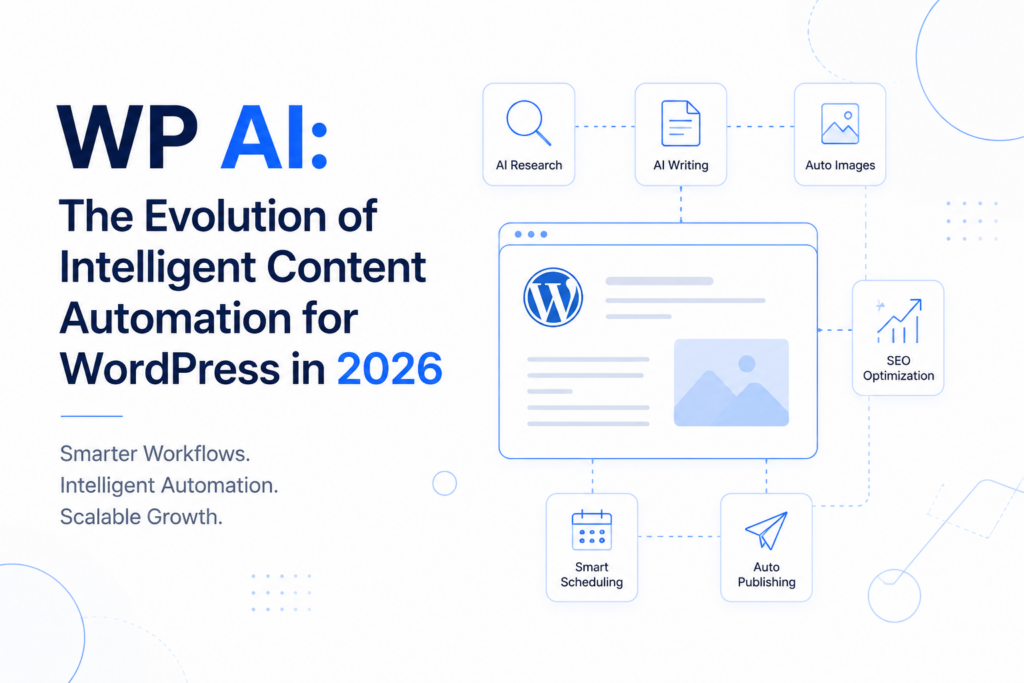
The conversation around AI in WordPress has changed dramatically over the past few years.
The first generation of AI plugins focused almost entirely on one task: generating text from prompts.
While impressive at the time, these tools still required users to copy content, edit formatting, upload images, optimize SEO, schedule publishing, and manage every step manually.
AI made writing faster, but it didn’t truly automate content marketing.
In 2026, WP AI represents something much bigger.
Rather than acting as a chatbot inside the WordPress dashboard, modern AI systems are becoming intelligent publishing engines capable of planning, generating, formatting, optimizing, scheduling, and publishing content with minimal human intervention.
The goal is no longer to ask AI to write a single article.
The goal is to build an automated content workflow that continuously supports your SEO strategy while you focus on growing your business.
Whether you’re a blogger, agency, niche site builder, or business owner, understanding this evolution is essential if you want to scale content production without sacrificing quality.
In this guide, we’ll explore how WP AI has evolved, why traditional prompt-based workflows are becoming outdated, and what the next generation of intelligent WordPress automation looks like.
What Does “WP AI” Mean Today?
When people search for WP AI, they’re often looking for different things.
Some want an AI writing plugin.
Others are searching for SEO automation, image generation, chatbot integrations, or workflow tools.
The reality is that WP AI has become an umbrella term describing the growing ecosystem of artificial intelligence built specifically for WordPress.
Today, AI can assist with nearly every stage of the publishing lifecycle.
Instead of working as isolated tools, these capabilities increasingly work together.
Examples include:
- Keyword research
- Topic clustering
- Article generation
- SEO optimization
- Internal linking
- Featured image selection
- Content formatting
- Publishing schedules
- Performance analysis
- Content updates
The most valuable AI solutions aren’t those that perform one task exceptionally well.
They’re the ones that connect multiple tasks into a seamless workflow.
The First Generation of WordPress AI
The earliest AI tools focused on content generation.
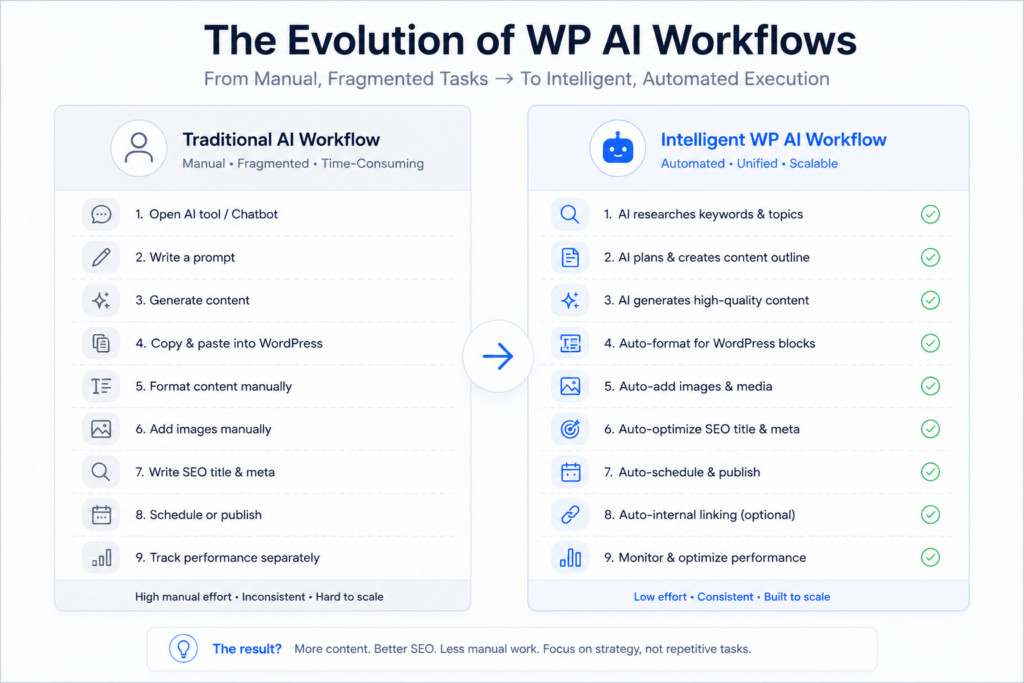
A typical workflow looked like this:
- Open an AI chatbot.
- Write a prompt.
- Generate content.
- Copy the output.
- Paste it into WordPress.
- Fix formatting.
- Add headings.
- Upload images.
- Write SEO metadata.
- Publish manually.
Although this reduced writing time, it still required significant human involvement.
Every article repeated the same routine.
As websites grew, this process became increasingly difficult to maintain.
Publishing ten articles might be manageable.
Publishing hundreds became a full-time job.
The bottleneck shifted from writing to workflow management.
Why Prompt Engineering Isn’t Enough Anymore
Prompt engineering played an important role in early AI adoption.
Users experimented with different prompts to improve article quality.
Entire communities emerged around creating the “perfect prompt.”
However, prompts alone don’t solve larger publishing challenges.
Consider everything that happens after AI generates text.
Someone still needs to:
- Review the article.
- Structure headings.
- Create internal links.
- Add images.
- Optimize metadata.
- Assign categories.
- Schedule publishing.
- Monitor SEO performance.
Prompt engineering improves one step of the process.
Content automation improves the entire process.
That’s the key difference defining modern WP AI.
The Shift Toward Intelligent Content Automation
The next generation of WordPress AI focuses less on generating isolated pieces of content and more on automating complete publishing workflows.
Instead of asking AI to write one article, users increasingly define broader publishing goals.
For example:
“Publish two beginner-friendly WordPress SEO articles every week targeting small business owners.”
Or:
“Generate a complete topic cluster around AI blogging over the next thirty days.”
The AI system then coordinates multiple tasks automatically.
It determines what content to create, formats articles for WordPress, applies SEO best practices, schedules publication, and maintains consistency across the website.
The user manages the strategy.
The AI manages the execution.
This shift represents one of the biggest changes in WordPress content marketing since the introduction of Gutenberg.
Why Automation Matters More Than Raw AI Writing
Generating text has become increasingly accessible.
Multiple AI models can now produce high-quality articles.
As a result, competitive advantage is shifting away from text generation itself.
The real value now lies in workflow automation.
Businesses that automate repetitive publishing tasks can:
- Publish more consistently.
- Reduce manual effort.
- Scale across multiple websites.
- Maintain a unified brand voice.
- Improve publishing reliability.
- Spend more time on strategy instead of production.
For agencies managing dozens of client websites, this difference is even more significant.
Instead of hiring additional writers simply to keep publishing schedules on track, automation allows existing teams to manage larger content operations more efficiently.
In the next section, we’ll explore what an intelligent WP AI workflow looks like in practice, how automation changes the role of content teams, and how modern WordPress plugins are evolving beyond traditional AI writing assistants.
What an Intelligent WP AI Workflow Looks Like
The biggest change in WP AI isn’t simply that AI writes faster.
It’s that AI can now orchestrate an entire publishing workflow from start to finish.
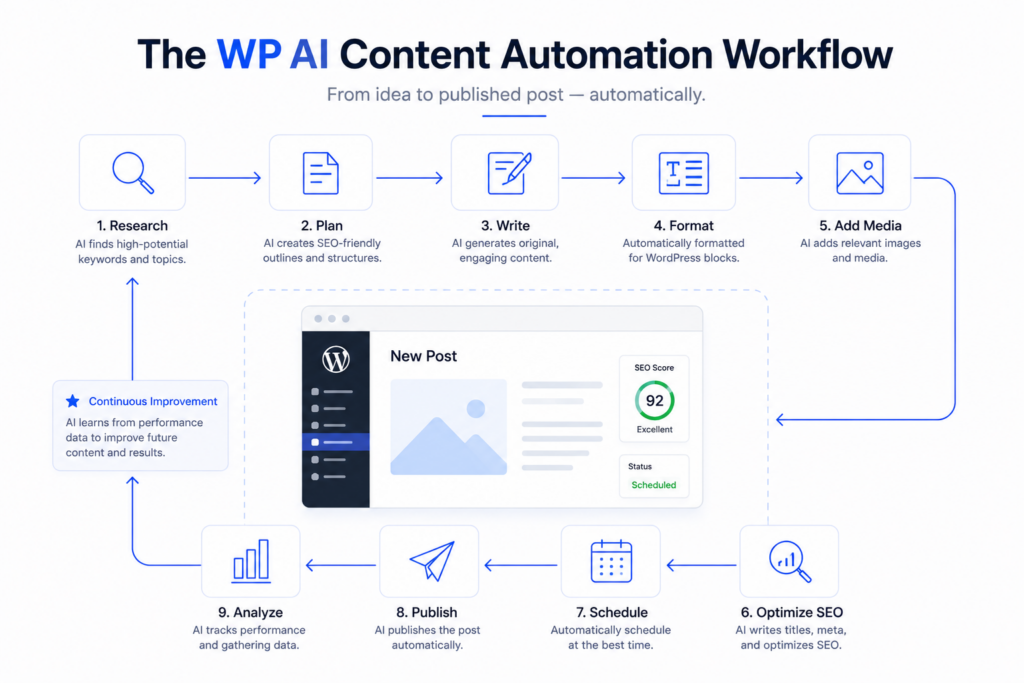
Instead of manually managing every step, a modern AI-powered WordPress workflow looks something like this:
- Identify target keywords.
- Generate supporting topic ideas.
- Create SEO-friendly article structures.
- Produce original long-form content.
- Format content into native WordPress blocks.
- Generate SEO titles and meta descriptions.
- Add relevant featured images.
- Schedule publishing automatically.
- Continue publishing based on your content calendar.
Rather than treating each article as an isolated task, WP AI transforms content creation into an automated production pipeline.
This allows website owners to spend less time operating software and more time improving their overall marketing strategy.
WP AI Is Moving Beyond Prompt-Based Workflows
Prompt-based AI tools still have their place.
They’re excellent for brainstorming ideas, rewriting paragraphs, or answering questions.
However, repeatedly opening a chatbot for every blog post creates unnecessary manual work.
A complete publishing workflow often involves much more than generating text.
Content creators still need to:
- Open WordPress.
- Copy and paste content.
- Format headings.
- Add images.
- Optimize SEO.
- Schedule publication.
- Create internal links.
- Maintain a consistent publishing calendar.
The future of WP AI is reducing these repetitive tasks through intelligent automation.
Instead of asking AI dozens of small questions every day, website owners increasingly configure a publishing strategy once and allow automation to handle routine execution.
How Hero AI Blogger Fits the Future of WP AI
This shift toward intelligent automation is exactly why we built Hero AI Blogger.
Rather than acting as another AI writing assistant, Hero AI Blogger functions as a complete WordPress publishing engine.
Instead of generating one article at a time, it helps automate the entire content lifecycle.
With Hero AI Blogger, you can:
- Create keyword-driven publishing campaigns.
- Configure your site’s audience and brand voice.
- Automatically generate WordPress-ready articles.
- Schedule posts using native WordPress Cron.
- Generate SEO-friendly metadata.
- Add royalty-free featured images automatically.
- Publish consistently without daily manual work.
Instead of spending hours managing repetitive publishing tasks, you define your strategy while the plugin handles execution in the background.
If you’re new to automated publishing, our guide on Build a High-Ranking WP Auto Blog in 2026 explains how to set up your first AI-powered publishing campaign and build a sustainable content workflow.
You can also explore everything Hero AI Blogger offers on our homepage at https://wpaiblogger.com/.
Why Native WordPress Automation Matters
Many AI tools generate content outside WordPress.
That usually means switching between multiple applications before an article is finally published.
Native WordPress automation removes much of that friction.
When AI operates directly within your publishing workflow, it can work with:
- Categories
- Authors
- Publishing schedules
- Featured images
- SEO plugins
- WordPress blocks
- Campaign management
- Site personas
Everything happens within the ecosystem your team already uses.
This creates a smoother experience while reducing opportunities for manual errors.
WP AI and SEO: Automation With Strategy
One common misconception is that AI automatically improves SEO.
In reality, AI is only as effective as the strategy guiding it.
Successful SEO still depends on:
- High-quality topic selection
- Search intent
- Topic clusters
- Internal linking
- Consistent publishing
- Helpful, original content
- Regular content updates
Modern WP AI platforms help execute these strategies more efficiently—they don’t replace them.
For example, publishing one excellent article every week is often more valuable than publishing ten disconnected articles in a single day.
Automation supports consistency, while strategy drives long-term results.
The Future of WP AI
The next stage of WordPress AI is moving beyond content generation entirely.
Future AI publishing systems will increasingly:
- Analyze search performance.
- Identify content gaps.
- Recommend new topic clusters.
- Update existing articles automatically.
- Improve internal linking.
- Personalize content for different audiences.
- Optimize publishing schedules based on historical performance.
- Integrate search data into content planning.
Instead of functioning as isolated writing tools, AI systems will become intelligent marketing assistants that continuously improve a website over time.
This evolution is already beginning, and WordPress is uniquely positioned to benefit because of its flexible publishing ecosystem.
Final Thoughts
The future of WP AI isn’t about writing articles faster.
It’s about building intelligent systems that execute an entire content strategy.
As AI continues to evolve, the most valuable tools won’t simply generate text—they’ll help plan, organize, publish, and optimize content within WordPress itself.
Whether you’re growing a personal blog, managing client websites, or scaling a content business, intelligent automation allows you to focus less on repetitive publishing tasks and more on creating long-term value for your audience.
That’s the direction WP AI is heading, and it’s only the beginning.
Try Hero AI Blogger Free on WordPress.org
Start with the free Hero AI Blogger plugin for WordPress and get 20,000 free monthly tokens every month, no credit card required.
Create your first keyword campaign, choose a publishing schedule, and see how an original-content workflow fits your site.
Need more tokens, longer articles, more sites, or advanced publishing capacity? Explore Hero AI Blogger Pricing.
Get Practical WP AI Growth Tips
Receive occasional WordPress automation, AI content, and SEO tips for bloggers, agencies, and site builders.
No spam. Unsubscribe anytime.