For years, WP autoblog plugins promised an attractive idea: install a plugin, connect an RSS feed, and automatically import articles while your website fills with content. On paper, it sounded like an effortless way to grow organic traffic.
In reality, many websites discovered the opposite. Duplicate content, poor formatting, thin articles, broken layouts, low user engagement, and minimal search visibility quickly became common problems.
The issue was not automation itself, but how it was implemented. Most traditional autoblogging plugins were designed during an era when publishing more pages often produced results, but search engines have changed dramatically since then. Today, quality, originality, helpfulness, and user experience matter far more than publishing volume.
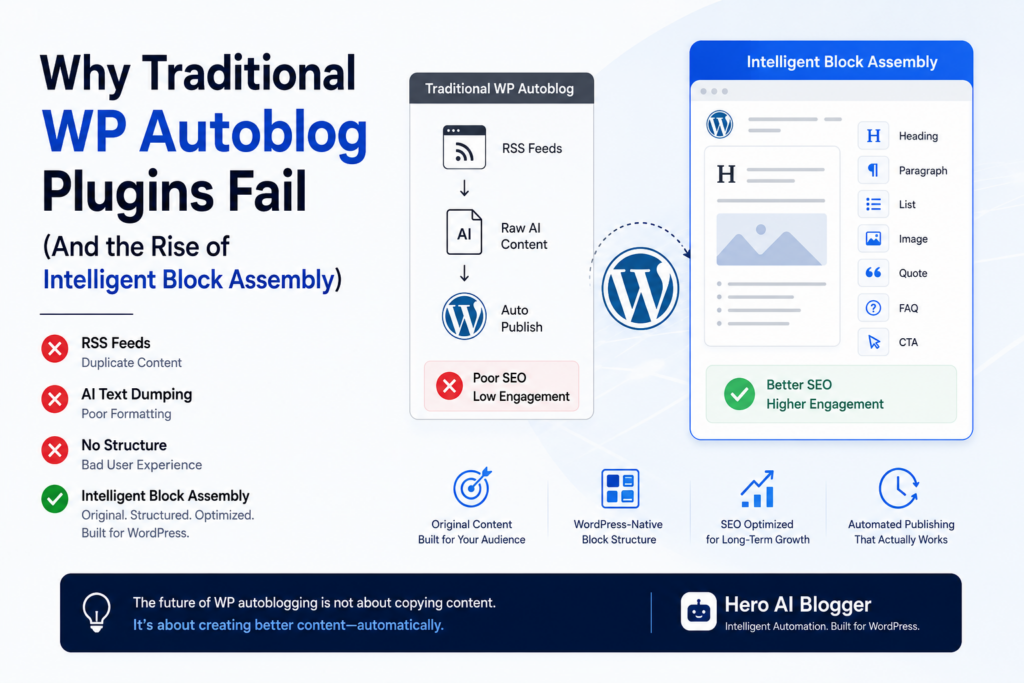
Modern WordPress automation requires a completely different approach. Instead of copying content from external sources or dumping raw AI-generated text into the editor, newer systems build complete WordPress-native articles using structured block-based content. This approach is commonly referred to as intelligent block assembly. In this guide, we’ll examine why traditional WP autoblog plugins struggle in today’s SEO landscape and why intelligent block assembly represents the next evolution of automated content publishing.
What Is a Traditional WP Autoblog Plugin?
The earliest autoblogging plugins were surprisingly simple.
Their primary purpose was to fetch content from another source and publish it automatically on a WordPress website.
Typically, this involved:
- Importing RSS feeds
- Republishing syndicated articles
- Scraping external websites
- Scheduling automatic imports
- Assigning categories
- Creating basic excerpts
Some later tools added AI rewriting to reduce duplicate content.
However, the underlying workflow remained largely unchanged.
External content entered WordPress with minimal understanding of search intent, topical authority, or user experience.
While these plugins reduced manual effort, they rarely produced content that genuinely helped readers.
Why RSS-Based Autoblogging No Longer Works
RSS feeds remain useful for news aggregation.
They’re not ideal for building long-term organic search traffic.
Search engines increasingly reward original, experience-driven content.
Simply republishing or lightly rewriting existing articles rarely creates additional value.
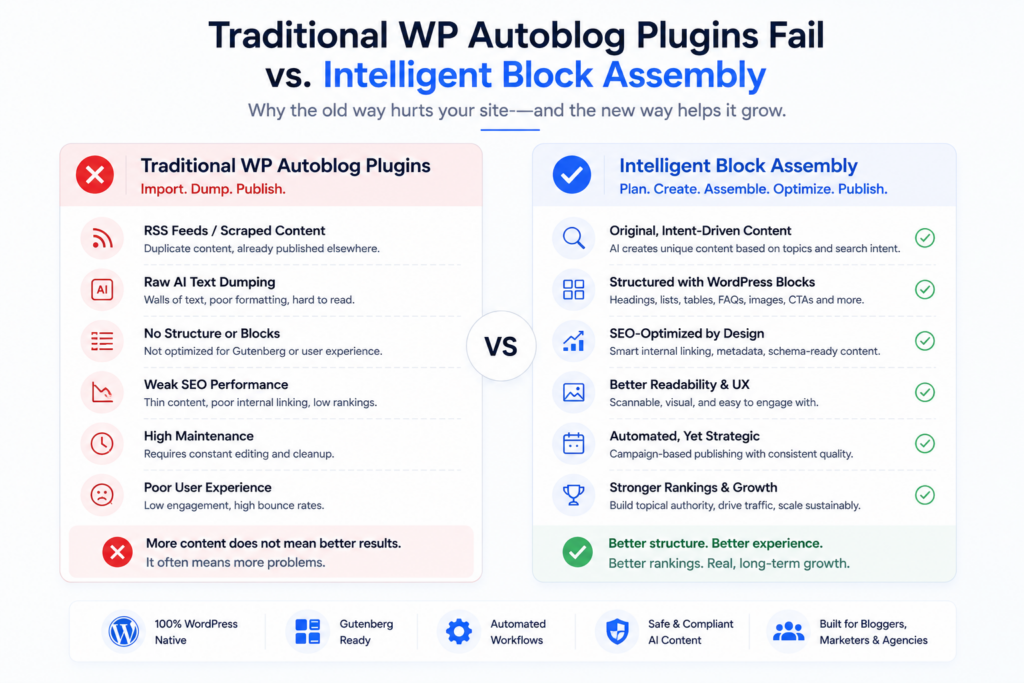
Common problems include:
- Duplicate information already available elsewhere.
- Weak topical authority.
- Inconsistent writing styles.
- Poor internal linking.
- Generic headlines.
- Outdated information.
- Thin content.
Even if AI rewrites portions of the article, the overall structure often mirrors the original source.
That limits originality and reduces the likelihood of achieving strong search visibility.
For websites aiming to build sustainable SEO traffic, relying solely on RSS imports has become increasingly risky.
The Problem With Raw AI Text Dumping
Many modern plugins replaced RSS imports with AI-generated articles.
This was certainly an improvement.
However, some tools simply take raw AI output and paste it directly into WordPress.
Although the content may be original, the publishing workflow often remains incomplete.
Common issues include:
- Large walls of text.
- Poor heading hierarchy.
- Limited internal linking.
- Missing featured images.
- Weak metadata.
- Generic formatting.
- Minimal use of WordPress blocks.
The result is technically original content that still feels unfinished.
Readers notice.
Search engines do too.
Publishing content isn’t just about generating paragraphs.
Presentation matters.
Structure matters.
Readability matters.
WordPress Is Built Around Blocks
Since the introduction of the Gutenberg editor, WordPress has evolved into a block-first publishing platform.
Every paragraph…
Every heading…
Every image…
Every list…
Every quote…
Every call-to-action…
exists as an individual block.
This architecture provides several important advantages.
Content becomes:
- Easier to edit.
- More visually engaging.
- Better organized.
- More reusable.
- More compatible with modern themes.
- Better suited for accessibility.
Unfortunately, many AI tools still treat WordPress as a plain text editor.
Instead of creating structured blocks, they simply inject large sections of generated text.
That misses one of WordPress’s biggest strengths.
Introducing Intelligent Block Assembly
Rather than thinking of content as one long document, intelligent block assembly treats an article as a collection of carefully organized components.
Instead of generating only text, the publishing engine builds:
- Headings
- Paragraphs
- Lists
- Tables
- Image placeholders
- FAQs
- Call-to-action sections
- Internal links
- SEO metadata
Each element is assembled into native WordPress blocks before publication.
The result feels much closer to content created by an experienced WordPress editor rather than pasted from an external AI tool.
Readers benefit from a cleaner reading experience.
Editors spend less time formatting.
Websites maintain a more consistent publishing standard.
In the next section, we’ll explore how intelligent block assembly changes automated publishing, why it supports better WordPress SEO, and how Hero AI Blogger uses campaign-based automation to generate structured, WordPress-native content rather than simple AI text dumps.
How Intelligent Block Assembly Improves WordPress SEO
Creating original content is only part of building a successful website.
Search engines also evaluate how content is structured, organized, and presented to readers.
This is where intelligent block assembly offers a significant advantage over traditional WP autoblog plugins.
Instead of publishing one large block of AI-generated text, each section of the article is intentionally assembled using native WordPress blocks.
A typical article may include:
- Clear heading hierarchy
- Short, readable paragraphs
- Bullet and numbered lists
- FAQ sections
- Call-to-action blocks
- Relevant images
- Internal links
- SEO-friendly metadata
This structured approach improves readability while making content easier to navigate for both visitors and search engines.
Most importantly, it creates articles that feel like they were carefully edited inside WordPress instead of automatically copied from another source.
From Content Importing to Content Creation
Traditional autoblogging focused on importing information.
Modern WordPress automation focuses on creating original content around user intent.
That difference changes everything.
Instead of asking:
“What content already exists that I can import?”
Modern publishing asks:
“What questions does my audience need answered?”
AI then generates unique content designed around those topics rather than recycling existing articles.
This helps websites build topical authority instead of simply increasing page count.
As search engines continue rewarding genuinely helpful content, this distinction becomes increasingly important.
Why Campaign-Based Publishing Is More Sustainable
One of the biggest weaknesses of older WP auto blog plugins is that they often publish content without an overall strategy.
Articles appear disconnected.
Topics overlap.
Publishing schedules become inconsistent.
Internal linking is usually forgotten.
Modern automation solves this through campaign-based publishing.
Instead of generating random posts, website owners define a topic, publishing frequency, content goals, and target audience.
The automation system then works toward that objective over time.
For example, instead of publishing twenty unrelated AI articles, a campaign could generate:
- A beginner guide
- Supporting tutorials
- Frequently asked questions
- Comparison articles
- Best practices
- Troubleshooting guides
Together, these articles reinforce each other through internal linking and topical relevance.
If you’re planning your own publishing strategy, our guide on Build a High-Ranking WP Auto Blog in 2026 explains how to structure campaigns that support long-term SEO growth.
How Hero AI Blogger Uses Intelligent Block Assembly
Hero AI Blogger was designed around this newer approach to WordPress automation.
Rather than acting as another AI writing assistant, it focuses on creating complete WordPress-ready articles that fit naturally into an automated publishing workflow.
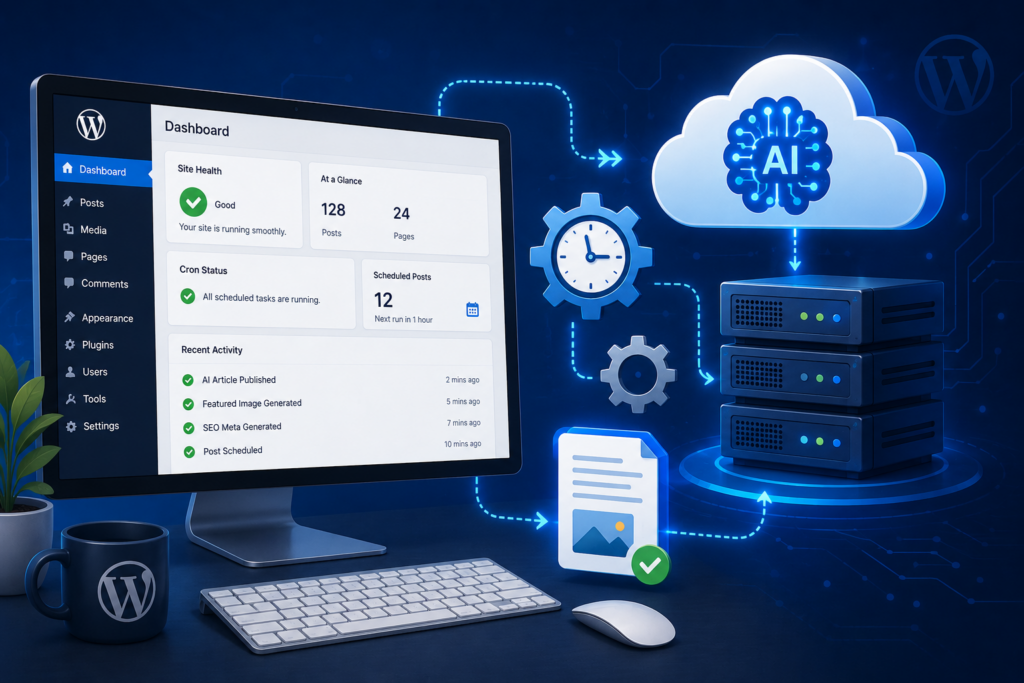
Instead of simply generating paragraphs, Hero AI Blogger can help automate tasks such as:
- Campaign planning
- Article generation
- Native WordPress block formatting
- SEO metadata creation
- Automatic featured images
- Publishing schedules
- Brand voice customization
This allows users to define a publishing strategy while repetitive production tasks happen automatically in the background.
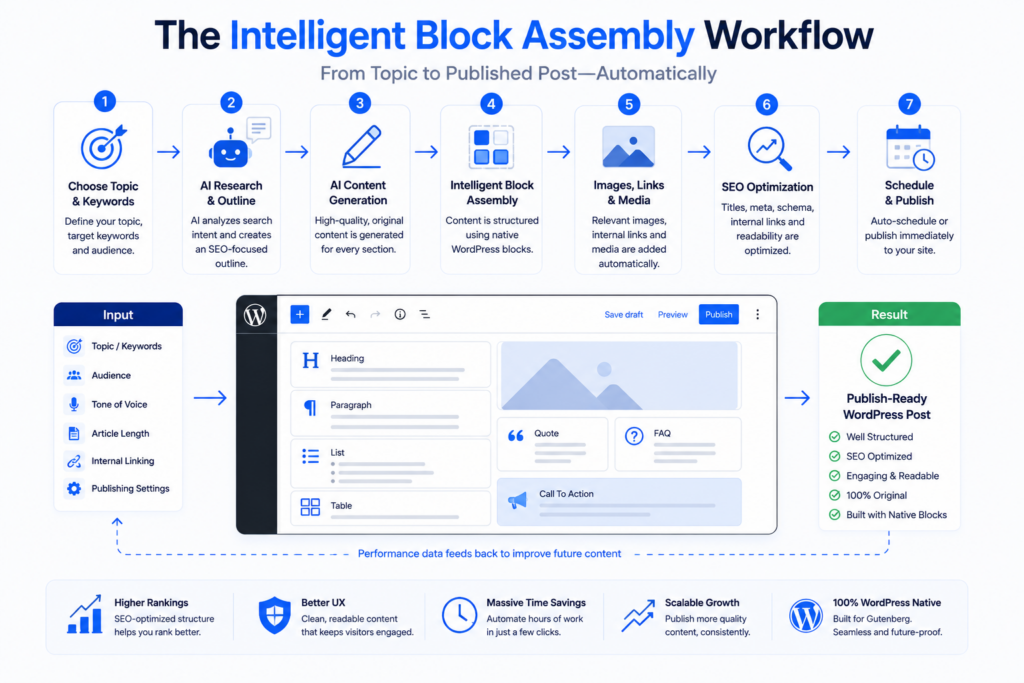
For agencies, bloggers, and businesses managing multiple websites, this significantly reduces manual effort while maintaining a consistent publishing process.
You can learn more about Hero AI Blogger and its automation capabilities by visiting the homepage at https://wpaiblogger.com/.
Automation Should Support Strategy—Not Replace It
Automation is most effective when it complements a well-planned content strategy.
Publishing hundreds of articles without clear goals rarely produces sustainable SEO growth.
Successful websites typically focus on:
- Understanding search intent
- Creating helpful content
- Building topic clusters
- Publishing consistently
- Updating older content
- Improving internal linking
Automation simply makes these activities easier to execute at scale.
For example, if you’re exploring how topic clusters improve rankings, you may also enjoy our guide on Scaling WordPress SEO: How to Generate Topic Clusters on Autopilot, which explains how connected content strengthens topical authority.
Likewise, reliable scheduling is essential for automated publishing. Our article on How to Prevent WordPress Cron Job Crashes During API Content Generation covers practical techniques for keeping automated workflows running smoothly.
Common Misconceptions About WP Autoblog Plugins
“More content always means better SEO.”
Not necessarily.
Publishing thousands of low-value pages often creates maintenance challenges rather than ranking improvements.
Quality consistently outperforms quantity over the long term.
“AI-generated content is automatically bad.”
AI itself isn’t the problem.
The quality of the workflow, editing process, publishing strategy, and user value determines the outcome.
Modern AI can help produce excellent content when combined with thoughtful planning and responsible automation.
“RSS autoblogging is enough in 2026.”
RSS feeds remain useful for monitoring industry news.
However, websites focused on long-term organic growth generally benefit more from publishing original content built around audience needs rather than republishing existing information.
“Automation removes the need for SEO.”
Automation accelerates publishing.
SEO still requires keyword research, search intent, internal linking, topical authority, and continuous improvement.
The best automation platforms support these strategies rather than replacing them.
Final Thoughts
The future of WP autoblog isn’t about copying content faster.
It’s about creating better content more efficiently.
Traditional RSS importers and raw AI text generators solved yesterday’s problems.
Today’s websites need automation that understands how WordPress works, how readers consume content, and how search engines evaluate quality.
Intelligent block assembly represents an important step in that evolution.
By combining structured WordPress blocks, campaign-based publishing, SEO-aware workflows, and original AI-generated content, website owners can build automation systems that save time while supporting sustainable organic growth.
Whether you’re running a personal blog, managing client websites, or scaling a content business, the goal should no longer be simply automating publishing.
The goal should be automating quality.
Try Hero AI Blogger Free on WordPress.org
Start with the free Hero AI Blogger plugin for WordPress and get 20,000 free monthly tokens every month, no credit card required.
Create your first keyword campaign, choose a publishing schedule, and see how an original-content workflow fits your site.
Need more tokens, longer articles, more sites, or advanced publishing capacity? Explore Hero AI Blogger Pricing.
Get Practical WP AI Growth Tips
Receive occasional WordPress automation, AI content, and SEO tips for bloggers, agencies, and site builders.
No spam. Unsubscribe anytime.